Hangbo Alloy Group
Shanghai · Est. 2012
UNS N19995 / AMS 7852 (powder) — An ultra-high-strength, powder-metallurgy nickel-base superalloy with the highest strength of the Rene family, engineered for advanced turbine discs, shafts and rotating components.
Rene 95 is an ultra-high-strength, powder-metallurgy (P/M) nickel-base superalloy developed for the most critically stressed rotating components in gas-turbine engines. It was one of the first superalloys produced primarily by the P/M route — vacuum-atomized powder consolidated by hot isostatic pressing (HIP), often followed by isothermal forging — which avoids the severe segregation inherent in conventional cast-and-wrought processing of such a highly alloyed chemistry.
Its outstanding strength comes from a very high volume fraction (≈47–50%) of fine gamma-prime (γ′) precipitate, achieved through a controlled "directly aged" heat treatment. This gives Rene 95 one of the highest strength levels of any polycrystalline nickel superalloy, with useful capability up to about 650 °C. It is the benchmark high-strength turbine-disc alloy, used in tens of thousands of high-pressure turbine discs and turbine blade retainers in commercial and military aircraft and helicopters worldwide.
Hangbo Alloy Group supports rotating-component programs with Rene 95 spherical powder, as-HIP preforms, extruded billet, and isothermally forged discs, rings and shafts — all qualified against the governing aerospace specification.
Hangbo Alloy Group supplies Rene 95 (UNS N19995) spherical powder, as-HIP preforms, extruded billet, and isothermally forged turbine discs, rings and shafts — with full powder certification, consolidation records, and NDT. Request a quote for your rotating-component program.
The chemistry of Rene 95 is heavily biased toward strengthening: multiple γ′ formers (Al, Ti, Nb) plus refractory solid-solution strengtheners (W, Mo, Co) produce its exceptional strength, while ~12–14% chromium provides adequate oxidation resistance for protected disc service. Typical (nominal) composition ranges are listed below.
| Element | Typical Range (wt%) | Role in the Alloy |
|---|---|---|
| Nickel (Ni) | Balance (~60–62) | Austenitic FCC matrix; high-temperature stability |
| Chromium (Cr) | 12.0 – 14.0 | Oxidation resistance; moderate hot-corrosion resistance |
| Cobalt (Co) | 7.0 – 9.0 | Raises γ′ solvus; solid-solution strengthening |
| Molybdenum (Mo) | 3.3 – 3.7 | Solid-solution strengthener in γ matrix |
| Tungsten (W) | 3.3 – 3.7 | Potent high-temperature strengthener |
| Aluminum (Al) | 3.3 – 3.7 | Primary γ′ (Ni₃Al) former |
| Titanium (Ti) | 2.3 – 2.7 | γ′ (Ni₃Ti) former; precipitation hardening |
| Niobium (Nb) | 3.3 – 3.7 | γ′ (Ni₃(Nb,Al,Ti)) former; raises strength |
| Carbon (C) | 0.04 – 0.07 | Carbides for grain-boundary strength |
| Zirconium (Zr) | 0.03 – 0.07 | Grain-boundary reinforcement; creep-rupture life |
| Boron (B) | 0.006 – 0.015 | Grain-boundary strengthening; ductility |
| Iron (Fe) | ≤ 0.5 | Controlled residual impurity |
| Tantalum (Ta) | ≤ 0.20 | Trace; optional strengthener |
Key insight: The combined Al+Ti+Nb content (≈9 wt%) drives a γ′ volume fraction of roughly 47–50%, far higher than conventional wrought alloys. This ultra-high γ′ content is the reason Rene 95 achieves its record strength, and why it must be made by powder metallurgy to avoid the macrosegregation that casting would produce.
Physical properties of consolidated Rene 95 are typical of a dense, heavily alloyed γ′-strengthened nickel superalloy.
| Property | Typical Value | Notes |
|---|---|---|
| Density | 8.27 – 8.29 g/cm³ | Consolidated P/M |
| Melting / Solidus Range | ~1267 – 1344 °C | Subsolidus solution below this |
| Gamma-Prime Solvus | ~1160 °C | Defines solution ceiling |
| Thermal Expansion (20–1000°C) | ~12.9 × 10⁻⁶ /°C | Mean coefficient |
| Thermal Conductivity | ~11.5 W/(m·K) at 100°C | Low; typical of Ni superalloys |
| Elastic Modulus (RT) | ~210 GPa | Decreases with temperature |
| Magnetic Properties | Non-magnetic (austenitic FCC) | |
| Property | Typical Value | Notes |
|---|---|---|
| Tensile Strength (Rm) | 1550 – 1650 MPa | Among highest of polycrystalline Ni alloys |
| Yield Strength (Rp0.2) | 1240 – 1350 MPa | Very high; defines disc capability |
| Elongation (A) | 8 – 16% (typ. 10–14) | Ductility retained after aging |
| Hardness | 36 – 44 HRC (~260–300 HBW) | High γ′ strength |
Rene 95 retains most of its strength at its 650 °C design temperature, which is what makes it suitable for high-speed turbine discs.
| Temperature | Tensile Strength (MPa) | Yield Strength (MPa) |
|---|---|---|
| Room Temp | ~1550 – 1650 | ~1240 – 1350 |
| 538 °C | ~1100 – 1150 | ~760 – 860 |
| 650 °C | ~1400 – 1450 | ~1100 – 1150 |
Rene 95 is optimized for creep and stress-rupture resistance up to about 650 °C. Representative published property requirements for consolidated parts are:
| Condition | Stress | Life |
|---|---|---|
| 650 °C | ~1034 MPa | ~25 h (rupture) |
| 650 °C (HP turbine shaft) | ~965 MPa | ~25 h (rupture) |
| 650 °C (creep) | ~552 MPa | ~100 h |
| ~650 °C (service) | up to ~1400 MPa | Sustained high stress |
Note: Exact values depend on consolidation route (as-HIP vs. extrude + isothermal forge), heat treatment, section thickness, and grain size. The figures above are typical published requirements for guidance; qualified engine limits are set by the governing OEM specification.
Rene 95 is made by powder metallurgy to achieve a homogeneous, fine-grained, segregation-free microstructure:
Rene 95 is typically used in the "directly aged" condition. Representative cycles are:
Contact Hangbo Alloy Group for Rene 95 (UNS N19995) spherical powder, as-HIP preforms, extruded billet, and isothermally forged discs, rings and shafts. Competitive Rene 95 price, fast quoting, full powder certification and EN 10204 traceability with ultrasonic / X-ray NDT.
Rene 95's chemistry is strongly biased toward strength, so its corrosion behaviour is secondary to its mechanical performance:
Hangbo Alloy Group supplies Rene 95 in the product forms used by turbine-disc and rotating-component manufacturers, manufactured and inspected to the governing engine / aerospace specification:
| Product Form | Specification / Reference | Typical Details |
|---|---|---|
| Spherical Powder | AMS 7852 (vacuum atomized) | AA ~20–100 µm; PREP ~50–150 µm |
| As-HIP Preforms / Billets | OEM P/M spec | Up to ~1.2 m diameter |
| Extruded Billet | OEM P/M spec | For subsequent forging |
| Isothermally Forged Discs / Rings | OEM disc spec | Grain size ASTM 10–12 |
| Machined Rotating Parts | Per drawing / OEM spec | Discs, shafts, blisks, retainers |
All products are supplied with powder certification, consolidation records, heat-treatment documentation, and non-destructive testing (ultrasonic / X-ray) as required by the engine specification.
| Standard / Spec | Description |
|---|---|
| AMS 7852 | Superalloy Powder, Nickel Base, 62Ni – 14Cr – 8Co – 3.5Mo – 3.5Nb – 3.5W – 2.5Ti – 3.5Al, Vacuum Atomized (powder precursor) |
| OEM Proprietary Specs | Engine-manufacturer process/property specs for consolidated discs, shafts, rings |
| FGH4095 (China) | Chinese equivalent powder-metallurgy grade of Rene 95 |
| UNS N19995 | Commonly cited UNS (confirm against procurement spec) |
| P/M Processing Spec | Defines powder quality, HIP, forging and heat-treatment controls |
| Property | Rene 95 | Inconel 718 | Udimet 720 | Waspaloy |
|---|---|---|---|---|
| Process Route | Powder metallurgy | Wrought / P/M | Wrought / forged | Wrought / forged |
| Typical Cr % | ~12–14 | ~17–21 | ~18 | ~19 |
| Typical Co % | ~8 | — | ~14.7 | ~13.5 |
| RT Tensile (MPa) | 1550–1650 | ~1275 | ~1500+ | ~1200–1300 |
| Service Temp | up to ~650 °C | up to ~650 °C | ~650–900 °C | ~650–870 °C |
| Oxidation / corrosion | Moderate | Good | Good | Good |
| Primary use | HPT discs, shafts | Discs, shafts, general | Discs, blades (high strength) | Discs, shafts, bolts |
Selection guide: Choose Rene 95 when maximum strength for high-temperature turbine discs and rotating parts up to ~650 °C is the priority and the higher cost/processing difficulty of P/M is justified. Inconel 718 is easier to process and more corrosion-resistant but much lower in strength; Udimet 720 offers comparable very-high strength in forged form; Waspaloy provides strong disc performance with better oxidation resistance at somewhat lower strength.
Rene 95 is an ultra-high-strength, powder-metallurgy (P/M) nickel-base superalloy developed for the most critically stressed rotating components in gas-turbine engines. It was one of the first superalloys produced primarily by the P/M route — vacuum-atomized powder consolidated by hot isostatic pressing (HIP), often followed by isothermal forging — which avoids the severe segregation seen in conventional cast-and-wrought processing. Its strength comes from a very high volume fraction (≈47–50%) of fine gamma-prime (γ′) precipitate, giving it one of the highest strength levels of any polycrystalline nickel superalloy, with useful capability up to about 650°C.
The nominal (typical) composition of Rene 95 in wt% is: Nickel balance; Chromium 12.0–14.0 (≈14); Cobalt 7.0–9.0 (≈8); Molybdenum 3.3–3.7 (≈3.5); Tungsten 3.3–3.7 (≈3.5); Aluminum 3.3–3.7 (≈3.5); Titanium 2.3–2.7 (≈2.5); Niobium 3.3–3.7 (≈3.5); Carbon 0.04–0.07; Boron 0.006–0.015; Zirconium 0.03–0.07; Iron ≤0.5; Tantalum ≤0.20. The combined γ′ formers (Al + Ti + Nb) and refractory solid-solution strengtheners (W + Mo + Co) are what produce its exceptionally high strength.
Typical physical properties of consolidated Rene 95 are: density 8.27–8.29 g/cm³; melting range ~1267–1344°C; gamma-prime solvus ~1160°C; mean coefficient of thermal expansion ~12.9 × 10⁻⁶ /°C (20–1000°C); thermal conductivity ~11.5 W/(m·K) at 100°C; elastic (Young's) modulus ~210 GPa; and it is non-magnetic (austenitic FCC matrix with high γ′ content).
In the fully heat-treated (typically 'directly aged') condition Rene 95 typically shows: room-temperature tensile strength 1550–1650 MPa, yield strength 1240–1350 MPa, elongation 8–16% (often 10–14%), and hardness ~36–44 HRC (≈260–300 HBW). At its design temperature of 650°C it still retains ~1400–1450 MPa tensile and ~1100–1150 MPa yield. These are among the highest values available for a polycrystalline nickel superalloy.
Rene 95 is optimized for creep and stress-rupture resistance up to about 650°C. Representative published property requirements for consolidated parts are: at 650°C / 1034 MPa, rupture life ~25 h (with ~2% elongation); at 650°C / 965 MPa, rupture life ~25 h (HP turbine shaft); and at 650°C / 552 MPa, creep life ~100 h. It is frequently described as sustaining very high stresses (up to ~1400 MPa) at around 650°C, with creep resistance stable to roughly 750°C.
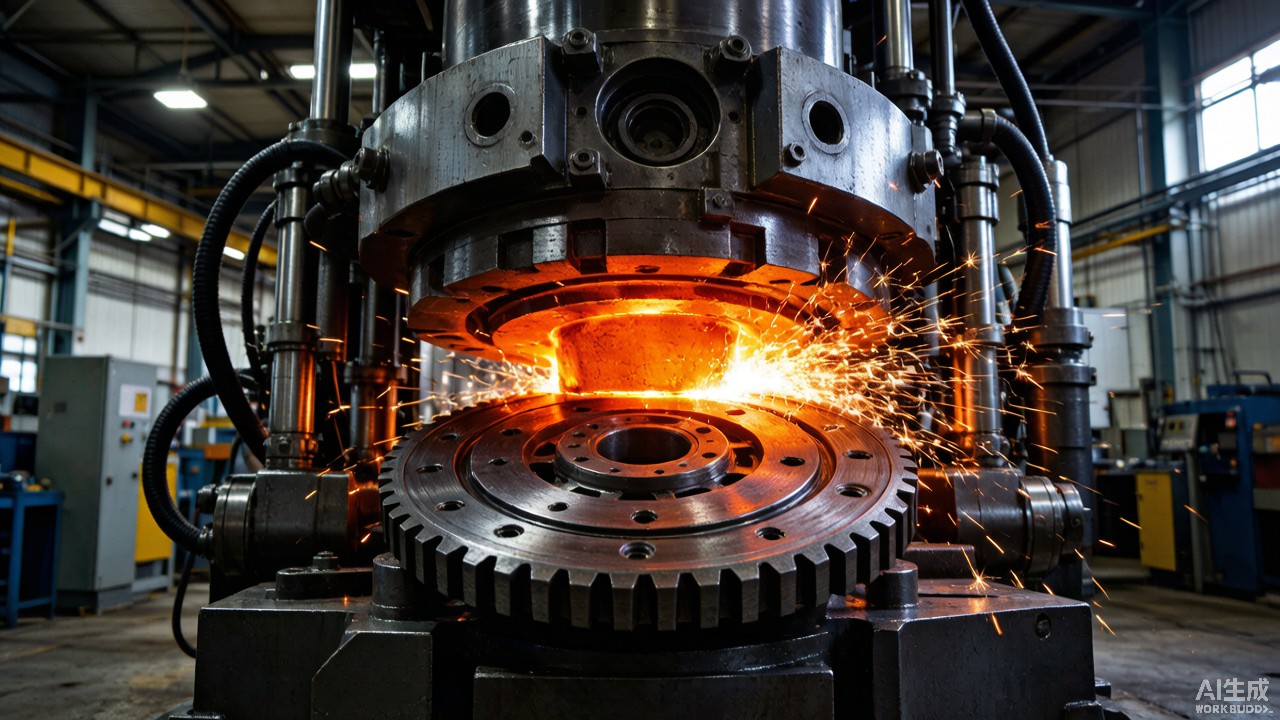
Rene 95 is made by powder metallurgy: a master heat is vacuum-induction melted, then atomized into spherical powder (argon atomization ~20–100 µm, or plasma rotating electrode ~50–150 µm). The powder is consolidated by hot isostatic pressing (HIP, typically ~1150–1200°C and 100–150 MPa, often ≥120 MPa for ≥2 h) to produce a fully dense, segregation-free preform. This preform is then isothermally forged (~1100°C) or extruded to refine the grain structure (ASTM grain size 10–12) before heat treatment. As-HIP preforms can be very large (up to ~1.2 m diameter).
A representative heat-treatment cycle for Rene 95 discs is: solution / homogenization at ~1120–1160°C for 2–4 h, salt or oil quench; intermediate aging at ~870°C for ~1 h (air cool); followed by a low-temperature aging at ~650°C for ~24 h (air cool). Rings use a slightly modified cycle (~1140–1160°C for 1–2 h + 870°C/1.5 h + 650°C/24 h). The alloy is typically used in the 'directly aged' condition to maximize its fine γ′ distribution and strength.
Rene 95 contains ~12–14% chromium, which gives it adequate oxidation resistance for the protected hot-section interior of a turbine disc, plus good resistance to the low-cycle fatigue and hot-salt environments typical of disc service. However, because its chemistry is heavily biased toward strength rather than corrosion, it is not a primary oxidation- or hot-corrosion-resistant alloy like Inconel 718 or Hastelloy grades; disc and shaft parts are normally protected by the engine environment and, where needed, by coatings.
Rene 95 is used almost exclusively for the most highly stressed rotating parts in gas-turbine engines, where failure is not an option: high-pressure turbine (HPT) discs, rear-stage compressor discs, turbine spools and hubs, turbine drum/shaft ( drum/shaft) sections, seals and deflector rings, turbine blade retainers, and integrally bladed rotors (blisks). Tens of thousands of HPT discs and retainers made from Rene 95 are in service on commercial and military aircraft and helicopters worldwide.
Rene 95 is the highest-strength of the group. Inconel 718 (P/M or wrought) is easier to process and more corrosion-resistant but much lower in strength (~1275 MPa UTS); Waspaloy is a strong disc alloy with better oxidation resistance but lower strength than Rene 95; Udimet 720 is also a very high-strength disc/blade alloy in the same league as Rene 95. Rene 95's defining advantage is its extreme yield/tensile strength for high-temperature turbine discs up to ~650°C, at the cost of more difficult processing and lower corrosion resistance.
The powder precursor for Rene 95 is governed by AMS 7852 ('Superalloy Powder, Nickel Base, 62Ni – 14Cr – 8Co – 3.5Mo – 3.5Nb – 3.5W – 2.5Ti – 3.5Al, Vacuum Atomized'). Consolidated product (HIP billets, forgings) is controlled by engine-OEM proprietary process specifications, often referencing AMS 7852 for powder quality. In China, the equivalent is FGH4095. Public trade references sometimes list UNS N19995, though this should be confirmed against the procurement specification.
Hangbo Alloy Group can supply Rene 95 in the forms used by turbine-disc and rotating-component manufacturers: vacuum-atomized or PREP spherical powder; as-HIP preforms and billets; extruded billet; isothermally forged discs, rings, shafts and blisk preforms; and finished machined rotating parts. All material is supplied with powder-certification, consolidation records, heat-treatment documentation, and NDT (ultrasonic / X-ray) as required by the engine specification.
Rene 95 is a premium, high-value superalloy whose price reflects its complex powder-metallurgy route, high cobalt/tungsten/niobium content, and stringent aerospace qualification. Pricing is quoted per kilogram for powder or per part for forged discs/rings, with premiums for tighter chemistry, finer powder, and full aerospace traceability. Lead times are typically several weeks to a few months depending on consolidation route, forging, heat treatment, and inspection. Contact serena@hangboalloy.com for a competitive quote.
Yes — Rene 95 is difficult to process. Its very high γ′ content and fine P/M microstructure make it hard to forge (requiring isothermal forging) and sensitive to overheating, and it is generally not considered readily weldable by conventional fusion welding; repairs of P/M disc material are tightly controlled or avoided. This is why the powder-metallurgy + isothermal-forging route and 'directly aged' heat treatment are the standard means of producing finished components, and why qualified aerospace specs govern every step.