
Hangbo Alloy Group
Shanghai · Est. 2012
Seamless rolled and die-forged nickel alloy rings to ASTM B564, SB564 and B637 for turbine casings, valve bodies, flanges and pressure vessel components.
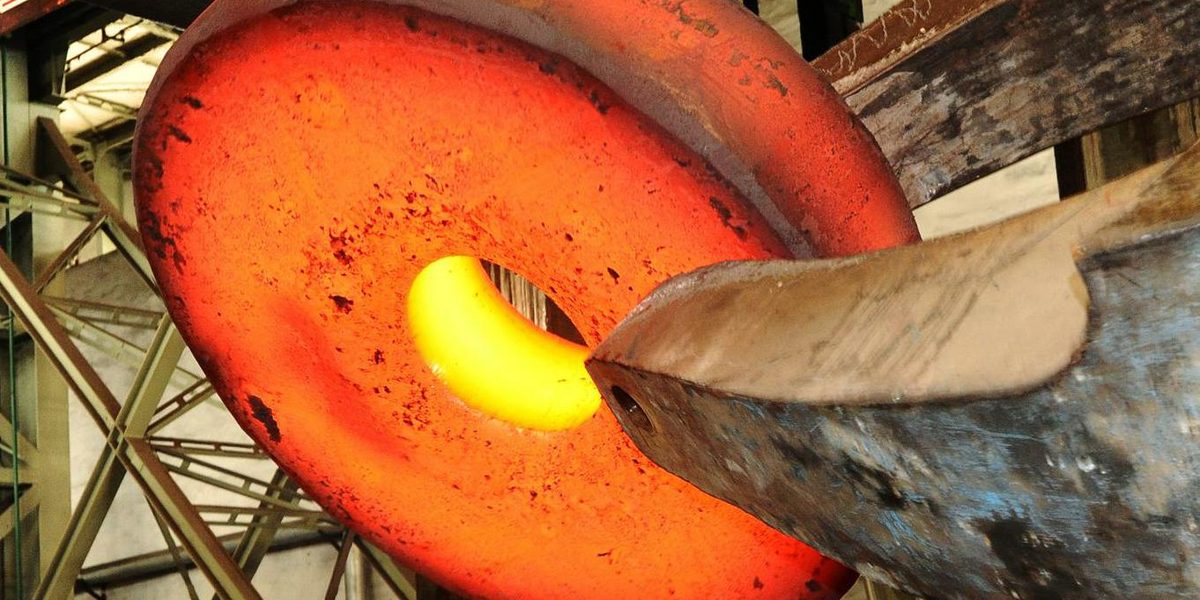
A seamless rolled ring is the preferred starting shape whenever a component is rotationally symmetric and has to survive pressure, temperature and fatigue without a weld seam. Because the grain flow follows the circumference of the ring rather than being interrupted by a weld, the hoop strength and fatigue life are significantly better than those of a ring cut from plate and welded closed. Hangbo Alloy Group supplies seamless rolled and die-forged nickel alloy rings for turbine casings, valve bodies and bonnets, compressor and pump housings, pressure vessel shells and heads, large-diameter nickel alloy flanges, hubs and rotating discs.
Rings are produced on a ring rolling mill from a pierced and upset preform, which allows the wall thickness and height to be controlled independently of the diameter. This means a single melt can yield rings across a wide diameter range, and the tooling cost is far lower than for a closed-die forging - an important advantage on the small and medium batch sizes typical of chemical, marine and power projects. Rings can be supplied as-rolled, rough-machined, or finish-machined to drawing on our machining partners' equipment.
Typical service includes steam and gas turbine casings running at elevated temperature, subsea valve bodies, high-pressure heat exchanger channels and shells built to heat exchanger alloy selection principles, hydroprocessing reactor internals, and large-diameter sealing rings for acid plant.
Our standard ring rolling capability covers the following envelope, with larger sizes reviewed case by case:
Dimensional tolerances are agreed at the enquiry stage against the drawing and the applicable forging tolerance class; as a general rule, concentricity and wall thickness variation after machining allowance are held within a few millimetres on the standard range. Rings are supplied with a defined machining allowance on all surfaces, or fully machined to the customer's finished dimensions and surface roughness requirement. Rectangular rings cut from rolled bar or plate with a weld seam are not supplied as seamless product - where a customer's design permits a welded construction it is quoted separately and clearly identified as such.
Rings are forged in the full range of commercial nickel alloys, with the heat treatment matched to the grade and the required mechanical properties:
For high-temperature rotating and pressure-retaining applications, the controlling properties are often creep and stress rupture rather than room-temperature tensile strength. Our creep and stress rupture guide explains how the design envelope is established and what data we can supply to support it.
The route begins with a vacuum-induction or electric-arc plus electroslag remelted ingot from an approved mill, which is cogged and forged to a billet to break up the as-cast structure. The billet is upset, pierced to create a doughnut-shaped preform, and then transferred to the ring rolling mill, where a driven mandrel and main roll reduce the wall thickness while the axial rolls control the height. Throughout the cycle the ring is held within the forging temperature window for the specific alloy - nickel superalloys have a comparatively narrow hot-working range, and falling below it risks edge cracking that cannot be repaired.
After rolling, rings receive the specified heat treatment in a calibrated, uniformity-surveyed furnace with full chart recording: solution anneal and rapid water quench for solid-solution grades, and solution treatment followed by the required ageing cycle for precipitation-hardenable alloys. Rings are then descaled, inspected, and either shipped in the as-rolled or rough-machined condition or forwarded for finish machining.
Because residual stress drives distortion during machining, rings intended for tight-tolerance machining are stress-relieved before the first cut. Machining sequences are planned so that the final dimensions are reached after the last stress-relief operation wherever the geometry allows it.
All manufacture and inspection is carried out under a quality management system certified to ISO 9001:2015, GJB 9001C and GOST R. Rings are released with an EN 10204 3.1 certificate; EN 10204 3.2 certification with independent witness by BV, SGS, TUV, DNV or Lloyd's Register is available and is common for pressure boundary components built to ASME Section VIII Division 1.
Standard inspection includes: review of the source melt certificate and full chemical analysis; tensile and hardness testing on prolongations or separately forged test pieces; impact testing where specified; ultrasonic examination to detect internal discontinuities; dye penetrant examination of the machined surfaces; and full dimensional survey against the drawing. Grain size, macro-etch and intergranular corrosion testing to ASTM G28 can be added for critical corrosion service.
Each ring is stamped or low-stress marked with the alloy designation, heat number, dimensions and manufacturer's identification, and the marking is transferred if the ring is subsequently divided. Complete heat-to-heat traceability is maintained from the melt to the finished component, and inspection reports, heat treatment charts and NDT records are retained and supplied with the shipment or on request.
Our standard seamless rolled ring range in nickel alloys runs from 200 mm to 3000 mm outside diameter, with wall thickness from 30 mm to 400 mm and height from 50 mm to 600 mm, at weights up to approximately 5 tonnes. Selected sizes up to 4000 mm outside diameter can be reviewed against the specific alloy and section. Because the wall and height are set independently on the ring mill, we can often produce several different diameters from the same melt, which keeps material utilisation high and shortens lead time.
ASTM B564 (and its ASME equivalent SB564) covers nickel alloy forgings and is the specification used for the solid-solution grades such as Inconel 625, Hastelloy C276 and C22, and Monel 400. ASTM B637 covers precipitation-hardening nickel alloy bar, forgings and forging stock and is the correct specification for age-hardened Inconel 718 rings. The distinction matters because the required mechanical properties and heat treatment differ; we confirm the governing specification with the customer at the quotation stage.
Yes. Rings can be supplied as-rolled, rough-machined with a defined allowance on all faces, or finish-machined to your drawing including contoured profiles, bolt hole drilling, grooves and sealing faces. For tight-tolerance work we stress-relieve before finish machining to control distortion. Send the drawing with the required surface finish and dimensional tolerances and we will confirm whether the geometry is achievable from a rolled preform or requires a contoured die-forged shape.
Send us your grade, diameter, length, quantity, and any special requirements. Our team responds within 10 minutes during business hours.