
Hangbo Alloy Group
Shanghai · Est. 2012
Solid and clad tube sheets, tube support plates and baffles drilled to your tube layout — from 300 mm to 3500 mm diameter, delivered with full ASME documentation.
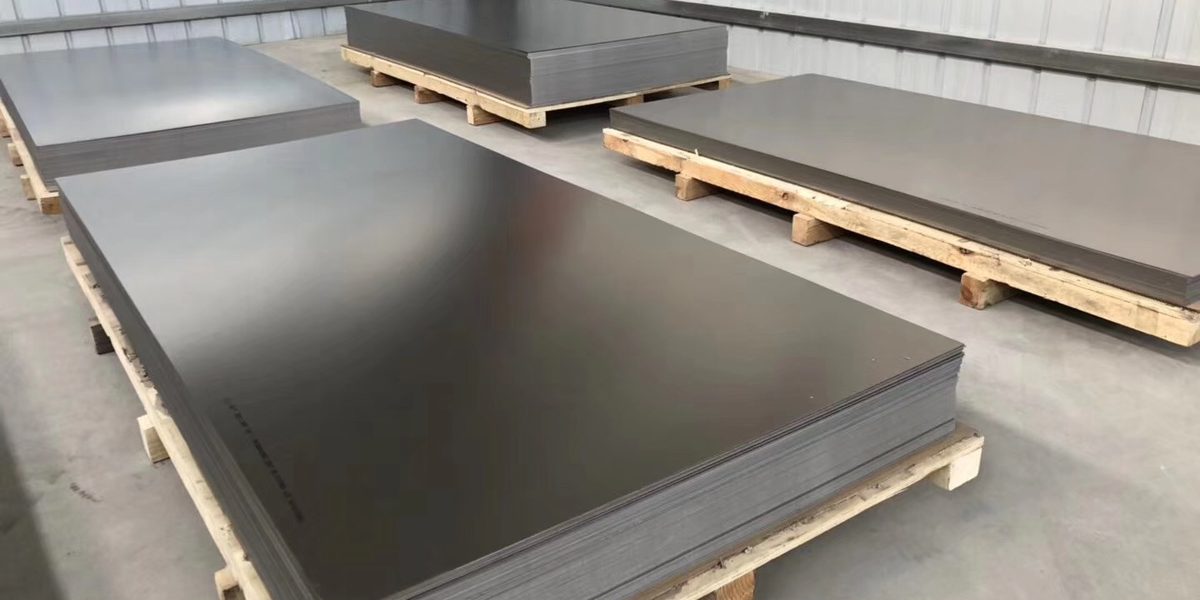
A tube sheet is the pressure-boundary plate that separates the shell side from the tube side of a shell-and-tube heat exchanger. It carries the tube ends, resists the differential pressure between the two circuits, and has to survive a service environment that is frequently more aggressive on one face than the other. Nickel alloy tube sheets are specified where carbon steel or stainless steel would suffer pitting, crevice attack, chloride stress corrosion cracking or general acid attack over the design life of the unit.
Shanghai Hangbo Alloy Group supplies solid nickel alloy tube sheets, explosively or roll-bonded clad tube sheets, weld-overlaid tube sheets, tube support plates, baffles and intermediate support plates. Diameters range from 300 mm for compact process coolers up to 3500 mm for large condensers and feedwater heaters, in thicknesses from 30 mm to 400 mm. Every plate is drilled to the customer's tube layout drawing and can be delivered fully machined with grooving, pass partition grooves, gasket seating faces, bolt holes and hub facing in a single package.
Because the tube-to-tubesheet joint is the most common leak path in a heat exchanger, we hold the tube hole tolerance, surface finish and ligament geometry tightly. Selecting the right alloy for the tube side, shell side and the tubes themselves is rarely a one-decision problem, which is why our engineers routinely review the process stream before confirming a material. See our heat exchanger tube alloy selection guide for the corrosion logic behind common grade choices.
Solid drilled tube sheets. Produced from ASTM B564 forgings or from ASTM B162, B127, B168, B443 and B575 plate depending on alloy. Solid construction is preferred when both circuits are corrosive or when the design pressure makes a bonded interface undesirable.
Clad tube sheets. A nickel alloy cladding layer, typically 6 mm to 12 mm finished thickness, bonded to a carbon steel or low-alloy steel base. We supply explosion-bonded and roll-bonded plate to ASTM B898 / ASME SA-265 practice, plus weld-overlaid tube sheets where the geometry is complex. Cladding delivers the corrosion resistance of a solid alloy on the wetted face at a fraction of the alloy cost, and the bond integrity is verified by 100% ultrasonic scanning.
Baffles, support plates and tie rod spacers. Drilled to the same layout with the clearances required by TEMA so that tubes can be threaded through the bundle without scoring.
Design and manufacturing codes. Plate thickness and ligament efficiency are calculated to ASME BPVC Section VIII Division 1, UHX rules for tubesheets, and layouts follow TEMA Class R, C or B. Material specifications commonly invoked are ASME SB-564, SB-162, SB-127, SB-168 and SB-443. Sour-service units are supplied to NACE MR0175 / ISO 15156.
Machining capability. CNC deep-hole gun drilling and BTA drilling give hole diameters from 10 mm to 60 mm with H9 to H11 tolerance and surface finish typically Ra 3.2 µm or better. Tube hole pitch patterns of 30°, 45°, 60° and 90° are standard, with concentric or quadrant layouts, pass partition grooves, double grooving for expanded joints, and chamfered hole entrances to protect the tube during expansion.
Tube sheets are held as forging billet, plate stock and finished drilled plates in the grades most frequently called out on heat exchanger datasheets:
When a unit fails early it is usually because one face was specified for the wrong environment. Chloride-induced cracking in austenitic stainless tube sheets is the classic case, and the mechanism is described in detail in our article on chloride stress corrosion cracking in nickel alloys. Matching tubes are supplied from our nickel alloy seamless tube programme so bundle components arrive as a matched set.
Hangbo Alloy Group manufactures under an ISO 9001:2015 quality management system, with GJB 9001C for defence-related work and GOST R certification for shipments into Russia and the EAEU. Tube sheets are delivered with EN 10204 type 3.1 inspection certificates; type 3.2 certification is arranged through third-party inspectors from BV, SGS, TUV, DNV and Lloyd's Register.
Standard verification includes 100% ultrasonic testing of the forging or plate to ASTM A388 / SA-578, ultrasonic bond testing over the full clad area, positive material identification on every plate and on a percentage of drilled holes, full dimensional reporting of the tube layout, and review of heat treatment records. Hydrostatic test records, weld overlay procedure qualifications and NDT personnel qualifications are included in the documentation package on request. Plates are packed on timber cradles with VCI protection and edge guards so that drilled holes and machined sealing faces arrive undamaged.
We regularly produce solid and clad tube sheets up to 3500 mm diameter in thicknesses to 400 mm. Above roughly 2200 mm the plate is normally supplied as a clad construction or built from a forged ring and centre plate, and we will advise on the most practical route once we have the tube layout and design pressure.
Send either. We work directly from a customer drilling drawing with tube count, pitch, pattern angle and pass arrangement, and we can also generate the layout from TEMA sheet data. Hole tolerance is supplied to H9 by default, with H11 available for expanded-only joints.
Yes. Explosion-bonded and roll-bonded clad plate with 6–12 mm of finished nickel alloy cladding is a common cost-effective option, and weld overlay to ASME Section IX qualified procedures is available where the geometry does not suit a bonded plate. All clad product is 100% ultrasonically scanned for bond integrity.
Send us your grade, diameter, length, quantity, and any special requirements. Our team responds within 10 minutes during business hours.