
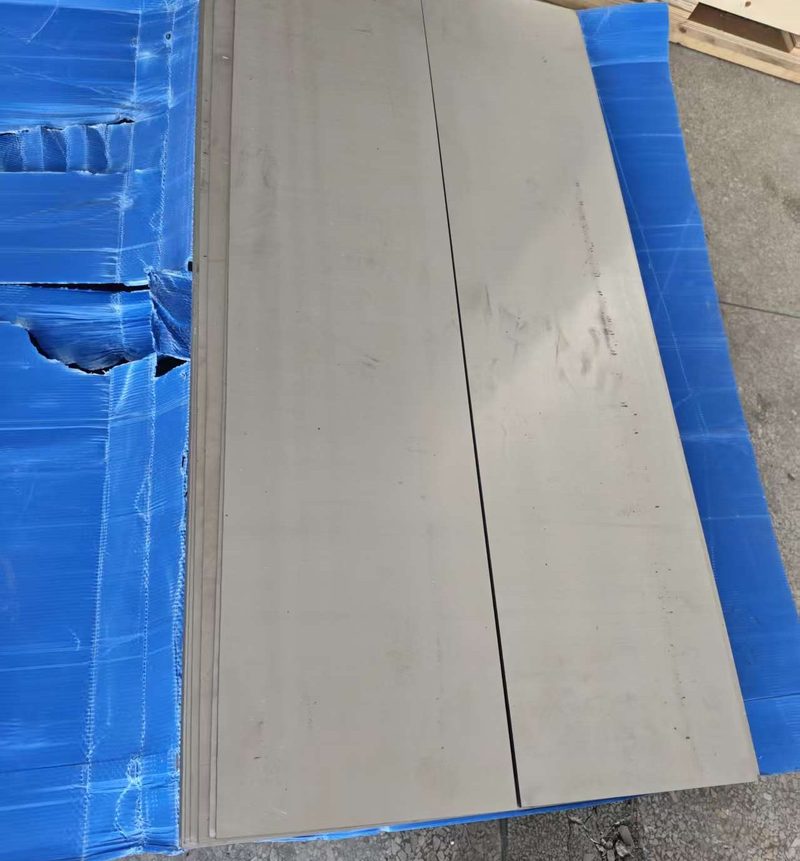
Overview
ЭИ698 (ХН77ТЮР-ВД) is the Russian equivalent of the world's most widely used superalloy — Inconel 718 (UNS N07718 / 2.4668). This precipitation-hardenable nickel-iron-chromium alloy is strengthened by both gamma prime (γ') and gamma double-prime (γ″) phases, with niobium as the key strengthening element. With outstanding strength and creep resistance to 650°C, it is the workhorse material for aerospace turbine discs, shafts, and high-temperature structural components.
Chemical Composition
| Element | ЭИ698 / Inconel 718 |
|---|---|
| Nickel (Ni) | 50–55% |
| Chromium (Cr) | 17–21% |
| Iron (Fe) | Balance |
| Niobium (Nb) | 4.75–5.5% |
| Molybdenum (Mo) | 2.8–3.3% |
| Titanium (Ti) | 0.65–1.15% |
| Aluminum (Al) | 0.2–0.8% |
| Cobalt (Co) | ≤ 1.0% |
| Carbon (C) | ≤ 0.08% |
| Density | 8.19 g/cm³ |
Mechanical Properties (AMS 5662)
| Property | Room Temperature | 650°C |
|---|---|---|
| Tensile Strength (Rm) | ≥ 1240 MPa | ≥ 1000 MPa |
| Yield Strength (Rp0.2) | ≥ 1034 MPa | ≥ 827 MPa |
| Elongation | ≥ 12% | ≥ 6% |
| 100-hr Creep Rupture (650°C) | ≥ 690 MPa | |
| Fatigue Strength 650°C (10⁷ cycles) | ~340 MPa | |
Heat Treatment — Double Aging
- Solution Annealing: 950–980°C, 1 hour, air cool
- First Aging: 710–730°C, 8 hours, furnace cool to 620°C at ≤ 50°C/hour
- Second Aging: 610–630°C, 8 hours, air cool
This two-stage aging precipitates both γ' Ni₃(Al,Ti) and γ″ Ni₃Nb, achieving the alloy's signature high strength.
International Equivalents
| Standard | Designation |
|---|---|
| GOST (Russia) | ЭИ698 / ХН77ТЮР-ВД |
| GB (China) | GH4169 |
| UNS (USA) | N07718 |
| EN/DIN | 2.4668 (NiCr19Fe19Nb5Mo3) |
| AMS | 5662, 5663, 5664 |
| ASTM | B637 (bar/forging) |
ЭИ698 vs ЭИ698-ВД — Triple Melt
For critical aerospace applications, ЭИ698-ВД (Vacuum Double Melt) is produced via VIM (Vacuum Induction Melting) followed by VAR (Vacuum Arc Remelting) or ESR (Electroslag Remelting). For the most demanding turbine disc applications, a triple melt process (VIM + ESR + VAR) is specified under AMS 5662/5663, ensuring:
- Ultra-low gas content (O, N, H)
- Superior micro-cleanliness (minimal non-metallic inclusions)
- Enhanced fatigue life
- Maximum property consistency
Aerospace Applications
- Turbine discs and compressor discs — to 650°C
- Turbine shafts
- High-temperature fasteners (bolts, studs)
- Nozzle guide vanes
- Gearbox housings
- Engines: GE CF6, Pratt & Whitney PW4000, SaM146, PS-90A (Russian)
Weldability
Inconel 718 has limited weldability — it is susceptible to HAZ cracking and strain-age cracking. Preferred methods include TIG (GTAW) with ERNiFeCr-2 filler, electron beam welding (EBW), and friction welding. Post-weld full double aging is mandatory. SMAW is not recommended for aerospace components.
Machining and Fabrication Practice
ЭИ698 is the Russian counterpart to Inconel 718 and shares its reputation for good weldability among γ″-hardened superalloys. Machining, however, is where most shops lose time and tooling.
- Machine in the solution-treated or over-aged condition, then final-age to reach specification — this is the standard route for 718-type alloys and applies equally here.
- Use carbide or ceramic tooling with positive rake, low cutting speed (20–40 m/min for carbide) and a continuous, uninterrupted cut.
- Avoid dwelling and light finishing passes that rub rather than cut; the surface work-hardens quickly.
- Weld by GTAW with ERNiFeCr-2 (718 filler); the alloy is notably resistant to strain-age cracking compared with other γ′/γ″ grades.
- Apply the standard double-age cycle (720 °C / 8 h, furnace cool to 620 °C / 8 h, air cool) after welding to restore properties.
For the underlying metallurgy see precipitation hardening of nickel superalloys; for direct comparison with the western grade, see Inconel 718.
Frequently Asked Questions
Is ЭИ698 a direct substitute for Inconel 718?
It is the closest Russian equivalent and is used for the same class of turbine discs, rings and fasteners. Confirm the specific variant — ЭИ698-ВД is the remelted, higher-cleanliness version preferred for rotating parts.
What is the maximum service temperature?
Around 650 °C for load-bearing aerospace parts. Above roughly 700 °C the γ″ strengthening phase coarsens rapidly and strength falls away; use a solid-solution alloy such as 617 or 230 for higher temperatures.
Can it be supplied with aerospace certification?
Yes — to GOST and Russian aviation specifications, or cross-certified to AMS 5662 / AMS 5663 equivalents on request, with full melt-to-part traceability.