
Hangbo Alloy Group
Shanghai · Est. 2012
A mill certificate proves the bar, not the flange. This buyer's guide shows how to verify finished nickel alloy flanges, fittings and bolts by positive material identification, component heat traceability and EN 10204 3.1.
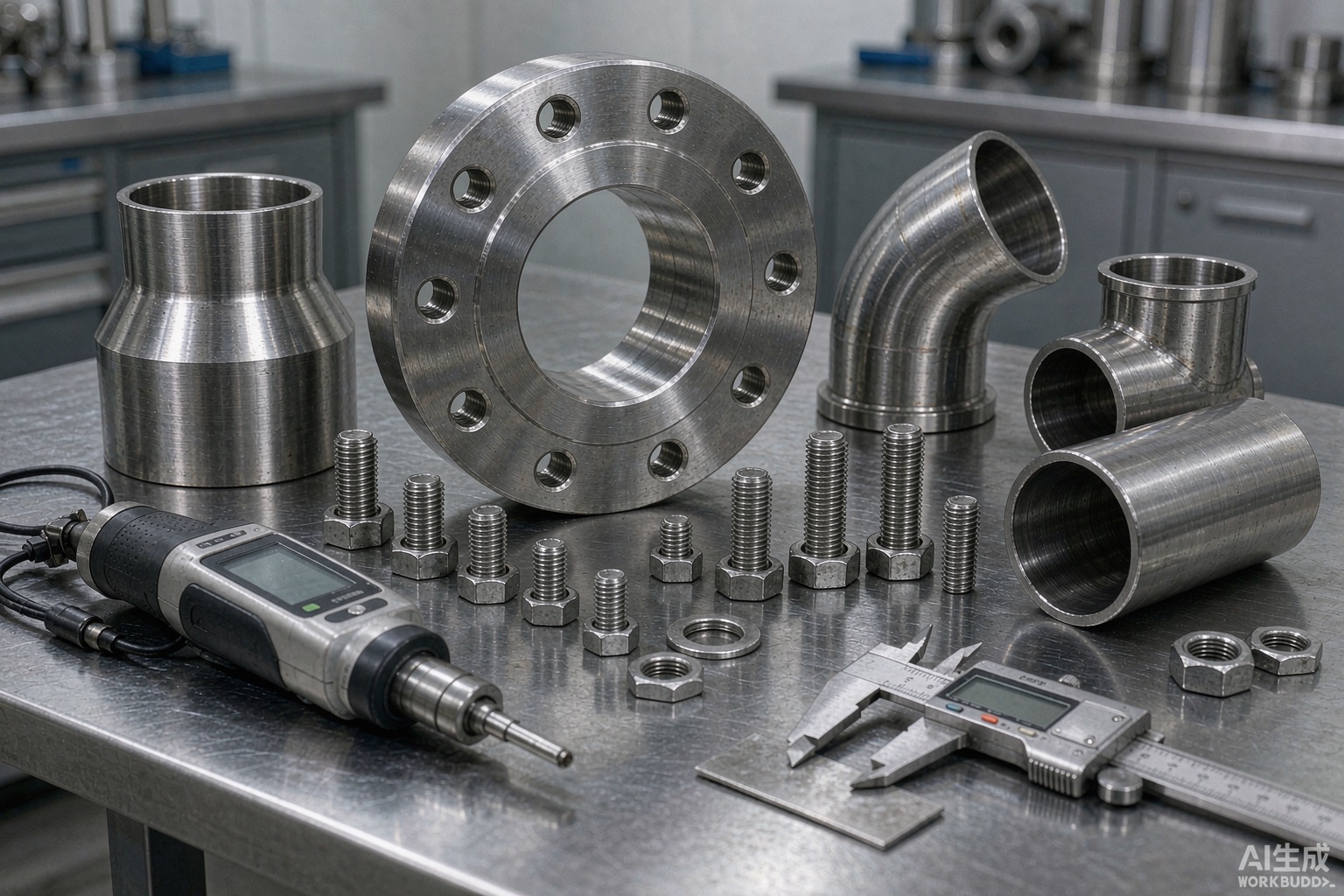
A mill test certificate for a bar, plate or tube proves the raw stock. It does not prove the flange, elbow, tee, forged block or bolt machined or welded from that stock is the same grade, because the component can be made from a different heat, a different alloy, or a substituted casting without the raw-material certificate ever changing. This guide is written for buyers who purchase finished nickel alloy components — flanges, fittings, fasteners and machined parts — and who need to verify that the part in the box is the alloy the order named, not just that the starting material was once the right chemistry.
We cover why a component is a different verification problem from raw stock, the common ways a finished part is quietly downgraded, the document and physical checks that catch it, the standards that govern component certification, and a ready-to-use set of purchase-order clauses. Our Inconel 625 guide, our Hastelloy C-276 composition guide and our Monel 400 guide define the grades most often called out for flanges and fittings, and they set the chemistry the component certificate has to match.
Short answer: a component can be made from a different heat or alloy than its raw-material certificate implies, so the part needs its own identification and checks rather than borrowed proof from the bar it came from.
When you buy raw stock, the heat number travels with the material and the certificate describes the exact object you receive. When you buy a flange or fitting, the object in your hand was produced by cutting, forging, machining or welding, and at each step a wrong heat or a wrong alloy can enter without the original certificate changing. A forging may be made from a billet of the right UNS but from a different heat than the one you audited; a fitting may be a genuine alloy part; a "matching" component may actually be a lower grade with the right label. The certificate for the starting bar says nothing about which heat was actually forged into your flange.
The second reason is traceability breakage. Components are often bought from distributors who hold stock from many heats and many mills, and the link between the physical part and a specific certificate can be loose unless the order demands it. A flange marked with the right grade but carrying no traceable heat number is, for verification purposes, an anonymous part, and an anonymous part cannot be defended in a claim. The verification problem is therefore to bind the physical component to a specific, correct certificate, not to assume the starting material's paper covers the finished shape, because the two are only as connected as the supplier's records make them.
From a procurement standpoint the cost of a wrong-grade component is rarely the metal; it is the downstream failure of a pressure boundary, a rotating part or a corrosive joint, plus the difficulty of proving what was supplied once the part is installed. Verifying the component at the point of receipt costs a fraction of that, which is why the checks below belong in the order rather than in a failure report, and why a clean raw-stock certificate is never a substitute for checking the part itself.
Short answer: the usual failures are a forged component from an unverified or wrong heat, a fitting or flange of a lower grade with a convincing label, a weld overlay or repair that changed the surface chemistry, and a component whose marking was never tied to its certificate.
| Failure mode | What it looks like | Where it hides | How to catch it |
|---|---|---|---|
| Wrong-heat forging | Right UNS, different or untraceable heat | Certificate covers bar, not the forged part | Require component heat number and PMI |
| Substituted grade | Lower alloy with correct-looking marking | Marking and label match the order | PMI the component, not just the paper |
| Cast-vs-forged swap | Cast part sold as forged component | Different grain and property envelope | Request forging ratio and macrostructure |
| Overlay or repair | Weld-built-up surface changes chemistry | Looks solid, surface is not the grade | Surface PMI plus UT where applicable |
| Loose traceability | Part has no heat number tied to cert | Marking absent or generic | Reject unmarked or unmatched components |
Most of these pass a paperwork review that only checks the raw-material certificate, which is why the verification has to happen on the component itself. A certificate reviewed in an office, before the part is opened, catches none of them, and a convincing label is exactly what a substituted grade is designed to carry, so the physical check is not optional for any part that carries a pressure or corrosion duty.
Short answer: identify the component directly with positive material identification, confirm its heat number matches a certificate that describes the component (not only the raw stock), and check marking, condition and — for welds — the filler grade.
| Check | What to require | Instrument / method | What a pass looks like |
|---|---|---|---|
| Component PMI | PMI on the actual flange, fitting or bolt | Handheld XRF or OES on the part | Measured chemistry matches the named UNS |
| Heat traceability | Component heat number on cert and part | Compare marking to certificate | Each part tied to its own heat record |
| Marking verification | Grade, heat, standard stamped or tagged | Visual and record check at goods-in | Marking matches the order exactly |
| Forging evidence | Forging ratio, macrostructure where relevant | Macroetch or mill record | Part is forged, not substituted cast |
| Weld and filler check | Filler grade named for welded parts | Review WPS and deposited-metal PMI | Weld chemistry matches the component grade |
The highest-value single check is positive material identification on the component itself, because it measures what is actually in the part rather than what the paperwork claims. Our nickel alloy welding guide matters here for any welded fitting or overlay, where the deposited metal must match the base grade or the joint becomes the weak point. For sour or chloride service, tie the component verification to our sour-gas selection guide and our NACE MR0175 notes, because a substituted grade can quietly breach the hardness and chemistry limits that keep sulfide stress cracking at bay, and the component is where that breach actually enters the system.
Short answer: require component-level certification — EN 10204 3.1 naming the part's heat, plus the product standard (ASTM / ASME B16 for flanges and fittings) — and positive material identification on the delivered part.
| Document | Covers | Buyer action |
|---|---|---|
| EN 10204 3.1 | Inspection certificate for the component's heat | Require 3.1 naming the part heat, not the bar |
| ASTM / ASME B16 | Flange and fitting dimensions and grades | Quote the product standard in the PO |
| ASME BPVC | Pressure-equipment material rules | Apply for vessel and pipe components |
| PMI acceptance | Positive material identification on receipt | Make it a receiving requirement |
| WPS / PQR | Procedure for welded components | Confirm filler grade matches base |
None of these certificates proves the part in your bay is the one described unless the heat number on the component matches the heat number on the certificate. The standard tells you what a grade must contain and how a flange must be dimensioned; it does not tell you which heat was actually forged into the part you received, and that link is the buyer's responsibility to close, because no standard can audit the supplier's internal heat routing for you.
Short answer: require component-level certification with its own heat number, make positive material identification a receiving requirement, forbid grade or heat substitution without approval, and specify the product standard and any welding procedure.
| Clause | What to require | Why it matters |
|---|---|---|
| Component certification | 3.1 naming the part's heat, not the bar | Binds the certificate to the actual part |
| PMI at receipt | Identify the delivered component directly | Catches substituted or wrong-heat parts |
| Marking requirement | Grade, heat, standard on every part | Makes each component traceable |
| No substitution | Written approval for any grade or heat change | Stops silent swaps of components |
| Product standard | ASTM / ASME B16 or equivalent | Fixes dimensions and grade basis |
| Weld control | Filler grade named; WPS/PQR provided | Protects welded fittings and overlays |
If the component is for offshore or subsea service, review our offshore and subsea selection guide alongside the grade checks, because the same part must satisfy both the corrosion envelope and the mechanical and certification rules, and a substitution that helps one can breach the other. For welded nickel alloy parts the filler grade is part of the component verification, and our Inconel 625 wire guide shows how the deposited metal has to be controlled so the joint is not the weak point, because a correct base with a wrong filler still leaves the seam as the failure site.
Put these into every inquiry or order that includes flanges, fittings, fasteners or machined nickel alloy parts:
No. The starting-bar certificate describes the raw stock, not the forged, machined or welded part made from it, and a different heat or grade can enter during component production without that certificate changing. The component needs its own identification and, ideally, a 3.1 certificate that names the part's heat, because only that binds the paperwork to the object you received, rather than to the bar it may have come from.
No. A convincing label is exactly what a substituted grade is designed to carry, so marking that matches the order on sight proves only that the label is good, not that the metal is. Positive material identification on the part itself is what confirms the chemistry, and it should be a receiving requirement for any critical component, because the eye cannot read alloy composition.
Yes. A casting and a forging of the same UNS can have different grain structure, different property envelopes and different defect signatures, so a cast part sold as a forged component is a different object mechanically even when the chemistry matches. Request the forging ratio or macrostructure evidence where the application depends on it, because the two are not interchangeable in fatigue or pressure service.
Treat the weld as part of the component: confirm the filler grade by UNS, review the WPS and PQR, and run positive material identification on the deposited metal where the joint is critical, because a correct base with a wrong filler still leaves the seam as the weak point. The deposited chemistry, not the base certificate, decides the joint's corrosion resistance, so the filler is not a detail to skip.
Not by paperwork alone. Distributors often hold many heats and mills, and the link between a physical part and a specific certificate can be loose unless the order demands it. Require the part's own heat number and a receiving PMI so the component is traced to a specific, correct certificate rather than assumed from the distributor's inventory, which may mix heats freely.
Treat an unmarked or generically marked component as untraceable and reject it for critical service, because an anonymous part cannot be defended in a claim and cannot be tied to any certificate. The marking requirement should be written into the order so the supplier cannot deliver an unmarked part in the first place, and a rejection at goods-in is far cheaper than a field failure.
The grade names are third-party trademarks; the properties are defined by UNS and ASTM standards. Inconel is a registered trademark of Special Metals Corporation and Hastelloy of Haynes International, so reference the UNS and the applicable product standard when you specify, and treat the trade name as a convenient label rather than the controlling document.
If you are buying flanges, fittings, fasteners or machined nickel alloy parts and want the component in the box to be the alloy the order named, send us the grade, product standard, service environment, quantity and any welding detail. We will forge, machine and weld in our Shanghai plant from double-melted, virgin-charge stock, certify the component to its own heat, and supply fully traceable parts with positive material identification available at receipt. Response time is typically ten minutes, and we ship worldwide.
Email: serena@hangboalloy.com
Phone: +86 166 2109 2936
WhatsApp: +86 166 2109 2936
Send us the grade, product standard, service environment, quantity and any welding detail. We will forge, machine and weld in our plant from double-melted, fully traceable stock, certify the component to its own heat, and quote parts with positive material identification available at receipt.