
Hangbo Alloy Group
Shanghai · Est. 2012
High-temperature nickel alloys are sold on creep and stress-rupture strength, yet that data is the hardest to check on arrival. This guide shows what a believable creep-rupture claim must contain, how to tell a measured heat-specific result from a generic curve, and where extrapolation runs out.
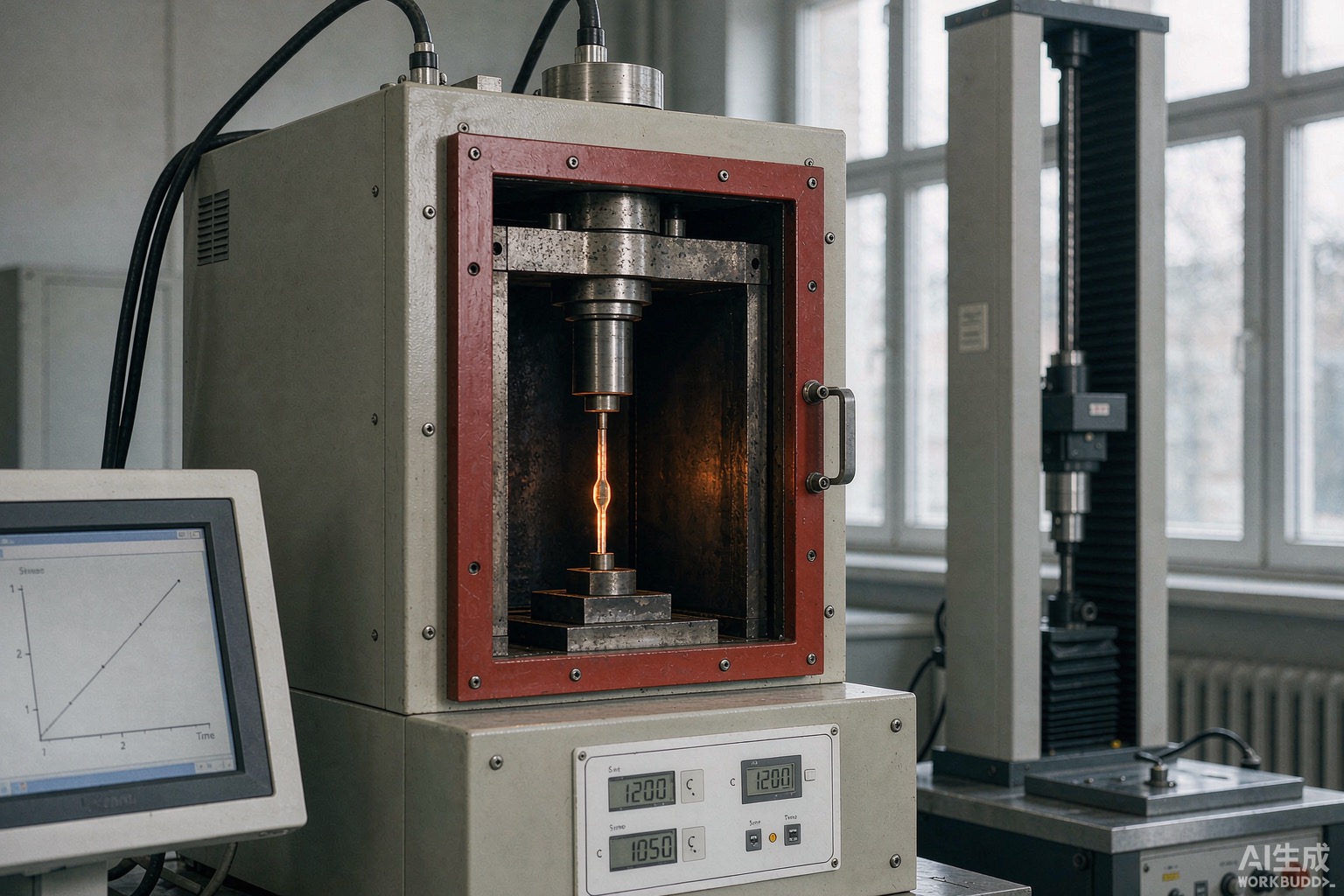
High-temperature nickel alloys are sold partly on their creep and stress-rupture strength, and that is exactly the data a buyer is least able to check on arrival. You can verify chemistry and tensile with a handheld analyser and a tensile coupon, but a 100,000-hour creep life is not something you measure at goods-in. So the number on the data sheet has to be trusted — and trusting it without knowing how it was produced is how buyers accept a grade that will sag or crack in service. This guide is for engineers and purchasers specifying alloys such as Inconel 718, Hastelloy X or similar high-temperature grades, and who need to know what a creep-rupture claim must contain to be believable.
We explain why creep and rupture data are easy to misrepresent, what a single reported number actually represents, the difference between a minimum stress-to-rupture curve and one test point, how to tell whether the tested specimen was really your heat, where extrapolation runs out, and a set of verification steps and purchase-order clauses you can use. Our creep and stress-rupture article, our Inconel 718 and Hastelloy X pages give the grade context, and our procurement pitfalls guide lists the broader ways alloy data can be misstated.
Short answer: creep life is measured over thousands of hours at temperature, so almost no buyer can repeat the test, which lets a single point, a generic grade curve or a generous extrapolation stand in for real, heat-specific evidence.
Unlike chemistry, which a handheld analyser confirms in seconds, a credible creep result can take a year of testing a specimen at temperature under load. The buyer receiving the material today will never run that test, so the supplier's report is effectively unchallengeable at goods-in — unless the buyer knows what a legitimate report contains and asks for it up front. That asymmetry is what makes creep data a soft target: a number lifted from a generic grade curve, or extrapolated far past the tested time, can be presented as if it were measured on the very heat you are buying. Our selection guide shows how alloy choice is driven by these properties, which is why the data behind the choice has to be real.
The second reason is specimen relevance. A stress-rupture result is only meaningful for the exact composition, heat treatment and orientation of the specimen, and a result from a different heat, a different batch of melting or a differently oriented coupon can overstate the life of your part by a wide margin. When the data sheet does not tie the number to a specific test with a specific heat, the buyer is being asked to trust a curve, not a measurement.
Short answer: a creep-rupture number is the time a notched or smooth specimen survived at a stated temperature and stress before it broke, and it only describes that exact temperature, stress, heat and orientation.
| Field on the report | Why it matters | Red flag |
|---|---|---|
| Test temperature | Creep is highly temperature-sensitive | Rounded or unspecified |
| Applied stress | Life falls steeply with stress | No units or no level |
| Time to rupture | The actual evidence | Implied, not measured |
| Heat / lot identity | Ties data to your metal | Missing or generic |
| Specimen orientation | Properties vary with direction | Not stated |
Because creep life changes steeply with both temperature and stress, a number quoted without those exact conditions is close to meaningless. A claim of "100,000-hour life" with no stated temperature and stress tells the buyer nothing, and a temperature a few tens of degrees higher than your service condition can cut the life by an order of magnitude. The report has to state the conditions explicitly and tie them to a heat you can identify, which is the same discipline behind machining and traceability on the shop floor.
Short answer: a minimum stress-to-rupture curve shows the worst-case life across many tested heats at many conditions, while a single favourable point can be the best heat anyone ever made — and only the curve is safe to design with.
| Evidence type | What it supports | Design use |
|---|---|---|
| Single test point | One heat, one condition | Not for design |
| Mean curve | Typical behaviour | Reference only |
| Minimum curve | Worst tested heat | Safe design basis |
| Multi-heat scatter band | Spread of results | Confidence check |
The published minimum curve is built from the lowest results across many production heats, so designing to it leaves margin for the heat you actually receive. A supplier who hands you one long-life point and implies it is representative is showing you the best case, not the guaranteed case, and the gap between the two is where failures live. When evaluating a grade such as Inconel 625 or a precipitation-strengthened alloy, anchor the decision to the minimum curve in the recognised standard, not to a highlight result pulled from a brochure. Our creep article lays out how these curves are constructed.
Short answer: a creep result only covers the heat and the heat treatment of the specimen, so a number not tied to your specific heat and condition is not evidence about your material.
Creep and rupture strength depend on chemistry fine detail, on the double-melt route, and on the exact solution and ageing treatment, all of which vary from heat to heat. A report that cites "Alloy 718, typical data" without a heat identity is describing someone else's metal, and there is no guarantee your heat sits near the minimum, let alone at the quoted point. The buyer should require the creep or rupture evidence to reference the same heat number as the mill test certificate, or at minimum a heat of the same melt route and heat treatment, and should treat anything vaguer as unverified. This is the same traceability principle that protects you from a substituted grade in our procurement pitfalls guide.
Where the part is cast, forged or heavily worked, specimen orientation also matters: a longitudinal coupon can outlive a transverse one, so the report should state which direction the specimen was cut from, and the answer should match how your component is loaded.
Short answer: extrapolation beyond the longest tested time or outside the tested temperature band is a calculation, not a measurement, and the further it reaches the less you should trust it for a long-life design.
Design lives of 100,000 hours or more are far longer than most laboratory tests, so some extrapolation is normal — but it is done with the Larson-Miller parameter and similar time-temperature relationships, and it carries uncertainty that grows with distance from the data. A rupture life claimed at a temperature the lab never tested, or inferred from a test that ran a few hundred hours, is a projection that can be off by a factor that matters. Ask which temperatures and times the underlying tests actually covered, and treat any claim that reaches far outside that envelope as indicative only. The recognised grade references, including our Hastelloy X and Inconel 718 pages, state the conditions the properties are valid for, and the data sheet should stay inside them.
Short answer: require the test conditions and heat identity up front, compare the number against the published minimum curve, confirm the test envelope covered your service temperature and time, and reject any claim that cannot be tied to a measured, heat-specific result.
| Check | What it catches | Where to look |
|---|---|---|
| Test conditions stated | Vague life claims | Data sheet and report |
| Heat identity | Generic, not your metal | Cross-check MTC |
| Curve vs point | Best-case quoting | Minimum curve in standard |
| Test envelope | Over-extrapolation | Temperature and time range |
| Orientation | Mis-applied coupon | Specimen direction note |
None of these checks requires you to run a ten-year test. They require the supplier to show the work: the temperature, the stress, the time, the heat and the curve the number sits on. A supplier who cannot produce a heat-specific report and instead points to a generic curve should be asked to either provide the evidence or price the material as unproven. After the data is accepted and the part is made, our machining guide covers holding the dimensions through fabrication.
Short answer: require the published minimum stress-to-rupture curve as the design basis, heat-specific test evidence for any claimed life, the tested temperature and time envelope, and a prohibition on presenting extrapolated or generic data as measured.
| Clause | What to require | Why it matters |
|---|---|---|
| Design basis | Minimum curve from standard | Stops best-case design |
| Heat-specific data | Report tied to the heat | Proves it is your metal |
| Test envelope | Stated temperature and time | Limits extrapolation |
| Specimen orientation | Direction of coupon | Matches service load |
| No mislabelling | Extrapolated ≠ measured | Closes the loophole |
These clauses turn a trust-me number into a verifiable one before you pay, and they give you a basis to reject material whose claimed life rests on a generic curve or an unstated extrapolation. Fold them into the same order that specifies chemistry and heat treatment, because the three are one story: the alloy, the condition and the long-time strength all have to be the same heat, tested the same way. Our creep article is the technical backbone if you need to brief your own materials engineer.
Use this before you accept a high-temperature alloy on its creep or rupture claim:
Creep data reports the deformation or strain rate of a specimen under load at temperature over time, while stress-rupture data reports the time to fracture at a stated temperature and stress. Both describe high-temperature behaviour, but stress-rupture is usually the number a buyer designs a long-life component around, and both must state their exact test conditions to mean anything.
They can, but it is not evidence about your material. Creep and rupture strength vary from heat to heat with chemistry, melt route and heat treatment, so a generic "alloy typical" figure may describe a heat you never received. Require the reported data to reference the same heat number as your mill test certificate, or at minimum a heat of the same route and condition.
It is a time-temperature relationship that lets engineers estimate long-time rupture life from shorter, higher-temperature tests by combining temperature and the log of time into a single parameter. It is a legitimate way to extend data, but the further the estimate reaches outside the tested envelope, the wider the uncertainty, so treat far-extrapolated lives as indicative only.
No single practical test runs 100,000 hours, so design relies on the minimum curve plus recognised extrapolation within the tested temperature band. What matters is that the underlying tests covered your service temperature and a meaningful spread of times, and that the supplier can show the curve and the envelope rather than a single inferred number.
No. A single point is one heat at one condition and could be the best result ever recorded for that grade. Safe approval uses the published minimum stress-to-rupture curve across many heats and conditions, so the design keeps margin for the heat you actually receive rather than betting on a highlight.
For a design-critical claim, yes — the evidence should reference your heat number, or at least a heat of the same double-melt route and heat treatment and the same specimen orientation. Data with no heat identity is describing someone else's metal and should be treated as unverified, not as proof of your part's life.
Ask for the temperature and time range the underlying tests actually covered, and compare your service condition against that envelope. If the claimed life sits far outside the tested band, it is a projection, not a measurement; require it to be labelled as such and lean on the minimum curve for the real design margin.
If you are specifying a high-temperature nickel alloy and need creep and stress-rupture evidence you can actually trust, send us the grade, service temperature, stress and design life. Our Shanghai plant produces double-melted, virgin-charge stock with full chemical, mechanical and NDT control, and we supply heat-specific test evidence tied to the same heat number as the mill test certificate rather than a generic grade curve. Response time is typically ten minutes, and we supply worldwide.
Email: serena@hangboalloy.com
Phone: +86 166 2109 2936
WhatsApp: +86 166 2109 2936
Send us the grade, service temperature, stress and design life. We will supply double-melted, virgin-charge stock with full chemical, mechanical and NDT control and heat-specific creep or rupture evidence tied to your heat number, designed to the minimum curve, so you approve a measured result rather than a generic grade claim.