
Hangbo Alloy Group
Shanghai · Est. 2012
Thread galling cold-welds nickel alloy fasteners before they carry load, seizing Inconel 625, Hastelloy C-276 and Monel 400 bolts on first assembly. This buyer's guide shows why high-nickel threads seize and the exact fit, finish, coating and assembly clauses that stop it.
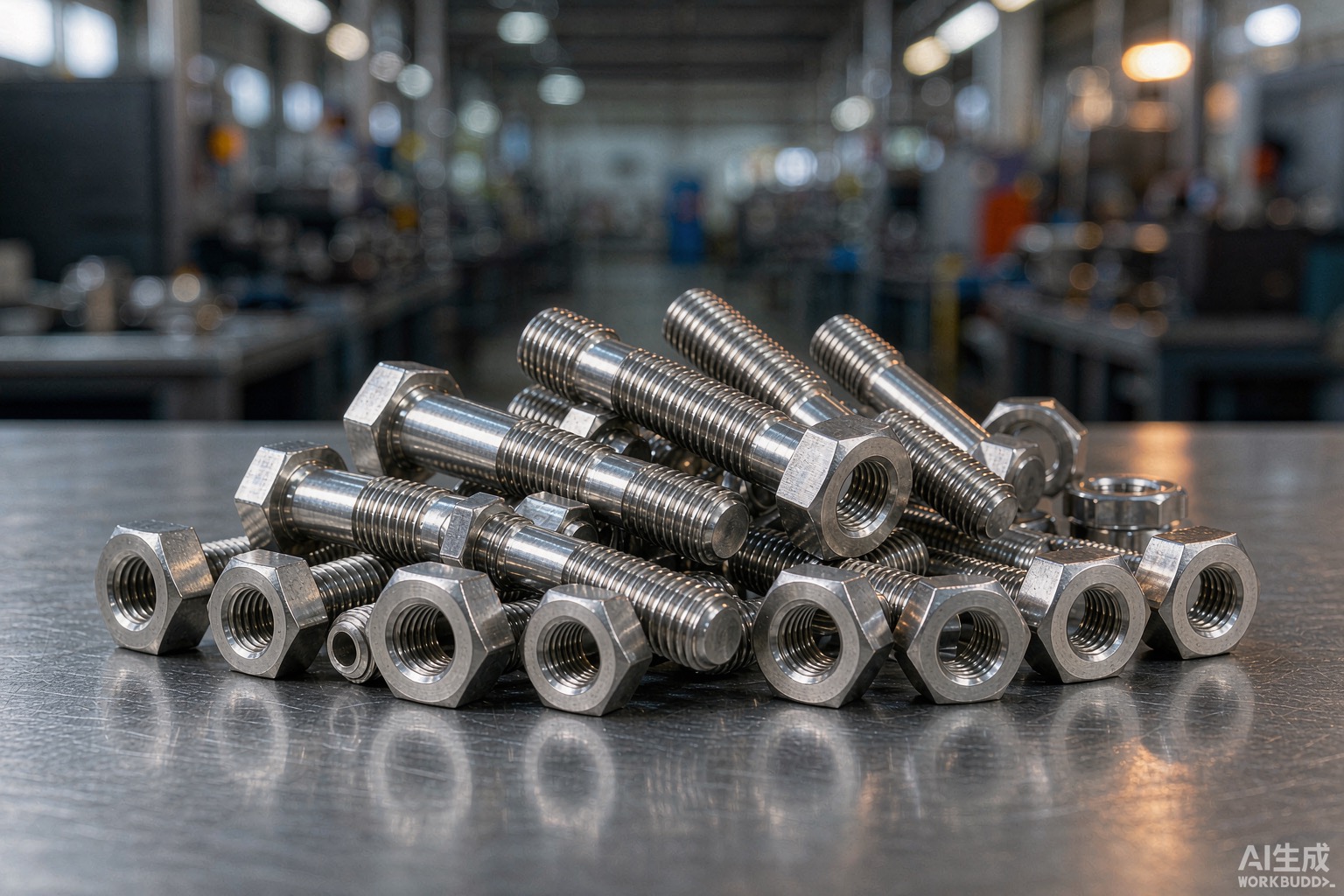
Thread galling is the single most common way a perfectly good nickel alloy fastener becomes scrap before it ever carries load. Two mating threads wipe each other's protective surface away, microscopic peaks weld together under pressure, and the joint seizes so hard that the bolt snaps at the head or the nut splits before the wrench torque matches the drawing. It happens on Inconel 625 studs, Hastelloy C-276 bolts, Monel 400 nuts and most other high-nickel fasteners, and it is almost always a specification or handling error rather than a material defect.
This guide is written for procurement managers, maintenance engineers and project buyers who specify nickel alloy bolting for flanges, pressure vessels, heat exchangers, exhaust manifolds and subsea connectors. It explains what galling actually is, why high-nickel alloys are especially prone to it, how to recognise a seized joint before it is cut out, the tests and surface measurements that catch it, and the exact purchase-order and installation clauses that prevent it. Every claim here is paired with something you can put in writing this week.
We see this failure often because Hangbo Alloy Group is a Shanghai nickel alloy manufacturer that melts, hot-forges, machines and finishes fastener stock and turned components in its own plant, with an in-house metallurgical laboratory running chemical, mechanical and surface analysis. Our melting route and finishing controls exist specifically to deliver threads that seat and release the way a drawing says they should, and the prevention steps below are the same ones we build into our own bolting. Where you need property baselines while you read, our Inconel 625 guide, our Hastelloy C-276 composition guide and our nickel alloy versus stainless selection guide cover the materials most often affected.
Short answer: galling is cold welding between two sliding metal surfaces, not ordinary wear. When the raised asperities on mating threads slide under high contact pressure, they generate local heat faster than it can dissipate, the thin work-hardened surface layer breaks down, and tiny points of the two metals fuse. Once that happens the joint stops sliding and starts tearing, and the torque curve climbs almost vertically instead of rising smoothly.
The failure usually arrives in three visible stages. First, the turning resistance becomes uneven and the wrench feels gritty. Second, bright shiny transfer marks appear on the thread flanks where metal has moved from one member to the other. Third, the nut or bolt head locks completely and any further force either shears the fastener or cracks the nut. On a flange that was supposed to be torqued to a controlled value, this turns a routine shutdown into a cutting-and-drilling operation.
Galling is distinct from corrosion seizing, where a joint is locked by rust or deposit rather than by metal transfer. The distinction matters for the buyer because the remedies are different: a corroded joint is a surface-protection problem, while a galled joint is a surface-hardness, lubrication and fit problem that begins the moment the threads touch.
Short answer: high-nickel alloys are ductile, work-harden rapidly, and lack the stable oxide skin that lets many steels slide. Their very corrosion resistance works against them under thread contact.
Four material traits combine. Nickel alloys are highly ductile, so under thread pressure the surface flows rather than cracks, producing fresh clean metal that wants to bond. They work-harden aggressively, meaning the contact points get harder and stickier as they deform. They form only a thin, easily-disrupted passive film rather than a thick tenacious oxide, so there is little built-in separation between the surfaces. And many of these grades are supplied in a bright, pickled or lightly passivated finish that offers almost no sacrificial layer to sacrifice during sliding.
This is why a carbon-steel bolt and nut can be run down repeatedly with little trouble, while an Inconel 625 stud and nut may seize on the first assembly. The same chemistry that gives the alloy its corrosion and high-temperature life is what makes its threads eager to cold-weld. Recognising this is the first step; the rest is controlling the contact.
Short answer: watch the torque curve, look for bright transfer bands on the thread flanks, and specimen-test any nut that turns more than a few degrees past its expected angle. Early signs are recoverable; late signs are not.
| Symptom | What it means | How to detect it | Can it be recovered |
|---|---|---|---|
| Uneven, gritty turning resistance | Surface asperities starting to shear and transfer | Compare running torque against a baseline on an identical, known-good fastener | Often, if you stop immediately and back off |
| Bright shiny bands on thread flanks | Metal has transferred from one member to the other | Visual or low-magnification inspection of the exposed thread | No — the surface is already damaged |
| Torque rises vertically with little angle gain | The joint has seized and is now tearing | Plot torque versus turn angle during assembly | No — stop and remove |
| Nut cracks or bolt snaps at the head | Seizure overload exceeded tensile or proof load | Fracture-surface review after removal | No — replace both members |
| Flange leaks despite correct final torque | One fastener seized early, leaving uneven gasket compression | Bolt-load survey with ultrasonic stretch measurement | Only by re-torquing the whole pattern with proven lubricant |
The cheapest detection method is also the most ignored: require a torque-turn record on the first article of every fastener lot. A normal assembly shows a smooth rising curve; a galling-prone lot shows the vertical climb long before the target torque is reached. Capturing that curve on one sample protects the whole batch.
Short answer: galling is a function of contact pressure, relative sliding speed, surface hardness and the absence of a separation layer — not of the nominal grade alone.
Under thread load the real contact area is a tiny fraction of the apparent area, so local pressure at the asperity tips is enormous. Those tips shear, expose clean metal, and because both members are the same reactive nickel alloy, they bond. Work hardening then raises the local hardness, which raises the shear strength of the bond, which raises the force needed to keep turning, which raises the pressure — a feedback loop that ends in seizure.
| Controlling factor | Effect on galling | What the buyer can specify |
|---|---|---|
| Contact pressure at the thread | Higher pressure accelerates seizure | Larger root radius, controlled thread form, correct fit class |
| Relative sliding speed during run-down | Fast, dry run-down promotes cold welding | Slow, controlled assembly; never impact-run nickel fasteners |
| Surface hardness and finish | Softer, brighter surfaces gall more easily | Defined surface roughness; hard coating where appropriate |
| Separation layer | No layer means direct metal-to-metal bond | Anti-seize compound or bonded coating in the PO |
| Thread fit | Tighter-than-needed fit raises pressure | 2A/2B or specified class, not forced fit |
Note that the alloy's corrosion resistance and its galling tendency come from the same metallurgy, so you cannot simply switch to a "non-galling" nickel grade. You control galling through finish, lubrication, fit and assembly method — which is exactly why it belongs in the purchase order and the work instruction, not just the material certificate.
Short answer: name the thread fit, the surface finish, the coating or anti-seize, and the assembly method, and make them inspection requirements rather than suggestions.
A certificate that says "Inconel 625, ASTM B446" tells you nothing about whether the threads will seize. The galling-control items are separate and must be stated explicitly. The table below is a ready-to-use clause set; copy the relevant rows into your inquiry.
| Specification item | What to require | Why it matters |
|---|---|---|
| Thread form and fit | Named standard and fit class (for example 2A/2B or 3A/3B as the service dictates) | Prevents forced, over-tight fits that raise contact pressure |
| Surface roughness | Maximum Ra on the thread flanks, typically in the low-micrometre range | Controls asperity height that drives local pressure |
| Coating or treatment | Permanent anti-galling coating (PTFE/Xylan type) or specified anti-seize | Provides the separation layer the bare alloy lacks |
| Finish condition | Bright, pickled or passivated, with no folded surface | Removes the soft surface layer most prone to transfer |
| Assembly method | Slow run-down, calibrated tool, no impact wrench | Eliminates the fast, dry sliding that welds threads |
| First-article proof | Torque-turn record on one sample from the lot | Detects a galling-prone batch before field use |
If your application is in sour or chloride service, tie the fastener specification back to our NACE MR0175 guidance and our sour-gas selection guide, because the hardness ceiling that prevents sulfide stress cracking is the same hardness the galling control must respect. A fastener that meets one requirement but breaks the other is not fit for service.
Short answer: a bonded fluoropolymer (PTFE/Xylan-type) coating gives the most consistent galling resistance, followed by a compatible anti-seize paste; plain oil alone is not enough for high-nickel threads.
Bonded dry-film coatings are applied in a controlled thickness and cured, so every fastener in the lot carries the same separation layer. That repeatability is why they outperform a dab of anti-seize applied by hand on site, where coverage and amount vary from one bolt to the next. For flanges that will be opened and re-closed repeatedly, a cured coating also survives the first disassembly better than paste.
Liquid and paste anti-seizes remain useful, especially for site assembly and maintenance, but specify the chemistry. Avoid products containing heavy-metal solids where your service environment forbids them, and avoid galvanic mismatches — the galvanic corrosion guide explains why a dissimilar contact layer on a nickel fastener can trade one failure mode for another. Where the joint must also resist crevice attack, review our PREN and crevice corrosion notes so the coating choice does not compromise corrosion life.
Short answer: assemble slowly with a calibrated tool, keep the thread axes aligned, use the specified lubricant, and never impact-run a nickel alloy fastener.
Misalignment is a hidden driver of galling. If the nut and bolt axes are not collinear, the threads rub on one flank instead of rolling, local pressure spikes, and seizure begins early. Guide the fastener, start the nut by hand for at least two full turns, and use a hardened washer with a suitable bearing surface so the nut turns instead of dragging.
Speed kills here. A pneumatic or electric impact tool can spin a nickel nut onto a stud so fast that the interface heats and welds before the torque limiter reacts. Train the crew to run down by hand or at low speed to seating, then tighten to the specified torque or tension with a calibrated wrench. For critical joints, measure bolt stretch ultrasonically so you are controlling load rather than guessing from a torque that a galled thread has already corrupted.
Short answer: lean on ASME, ASTM and API thread and fastener standards for the geometry, and on your own coating and assembly specification for the galling control that those standards do not fully cover.
| Document family | Covers | Buyer action |
|---|---|---|
| ASME B1.1 / Unified thread standard | Thread form, fit classes, gauging | Quote the fit class you require |
| ASTM F467 / F468 and grade-specific bars | Non-ferrous and nickel alloy fastener material | Name the ASTM grade and condition |
| API and NACE service requirements | Hardness ceiling, sampling, H₂S service | Apply where the joint sees sour or pressure service |
| ASTM F606 / F788 coating practices | Coating thickness and adhesion testing | Require coating verification on the lot |
| ASTM E18 hardness / surface finish practices | Hardness and roughness measurement | Request measured Ra and hardness on the certificate |
None of these documents alone prevents galling, because they describe the fastener, not the contact. The control lives in the combination of fit, finish, coating and assembly that you write around them.
Put these into every inquiry or purchase order that includes nickel alloy bolting and the failure rate drops sharply:
Almost always handling and specification, not the base metal. The alloy's chemistry makes its threads prone to cold welding, but a correctly finished, coated and slowly assembled joint will seat and release repeatedly. A seized fastener usually points to a missing coating, a forced fit, a misaligned start or an impact wrench — all controllable in the order and the work instruction.
A bonded fluoropolymer coating is the single most reliable control because it puts a uniform separation layer on every fastener in the lot. A hand-applied anti-seize paste helps but varies in coverage from one bolt to the next. Coating alone is not enough if the fit is forced or the assembly is run down at high speed, so pair it with fit and method control.
No. Once a joint begins to gall, extra torque only deepens the cold weld and usually shears the fastener or cracks the nut, turning a recoverable situation into a removal job. Stop the moment turning resistance becomes uneven or gritty, back the fastener off, inspect the threads, and re-assemble with proper lubrication and alignment.
Not necessarily, and sometimes the opposite. A harder thread can resist initial asperity shear, but in many nickel alloys raising hardness conflicts with the hardness ceiling required for sour service, and a very hard surface can still cold-weld under the extreme local pressures at the tips. Control finish, lubrication and fit first; treat hardness as a service-driven limit, not a galling cure.
Because both are high-nickel, highly ductile alloys that work-harden and lack a thick protective oxide, so both share the same underlying tendency. The specific grade matters less than the contact conditions. That is why the prevention steps — fit, roughness, coating, slow assembly — are the same across the nickel family, including the Monel 400 marine fastener case and the Inconel 625 case.
Require a first-article torque-turn record and a measured surface roughness from the lot. A good lot shows a smooth rising torque curve and a documented Ra; a prone lot shows the vertical climb and an out-of-spec finish. With a retained sample carrying the heat number, you can also have the coating thickness and hardness independently checked, which makes any future claim defensible.
Specify the fit class the joint actually needs rather than the tightest available. An over-tight fit raises contact pressure and promotes seizure, while a correctly chosen class (commonly 2A/2B for general service, tighter only where load demands it) gives enough clearance for lubrication and alignment. Let the service condition drive the choice, and state it in the order so the supplier cannot default to a forced fit.
If you are specifying nickel alloy bolting for flanges, pressure vessels, heat exchangers or subsea connectors and want threads that seat and release the way the drawing says, send us the grade, standard, thread form, dimensions and quantity, plus the service environment. We will confirm the right finish, anti-galling coating and assembly method for your condition, and quote our own vacuum-melted, in-house machined and inspected fastener stock with full heat-to-piece traceability. Typical response time is ten minutes, and we ship worldwide from Shanghai.
Email: serena@hangboalloy.com
Phone: +86 166 2109 2936
WhatsApp: +86 166 2109 2936
Send us the grade, standard, thread form, dimensions and quantity, plus the service environment. We will confirm the right surface finish, anti-galling coating and assembly method for your condition, and quote our own double-melted, in-house machined fastener stock with full heat-to-piece traceability.