
Hangbo Alloy Group
Shanghai · Est. 2012
A nickel alloy tube or pipe is not accepted by its grade name alone, it is accepted by the tests it passes. This guide lists the acceptance tests that actually catch a bad lot, bend, flatten, flare, hydrostatic and surface NDT, explains what each reveals, and gives the purchase-order wording that makes a failed test the supplier's problem.
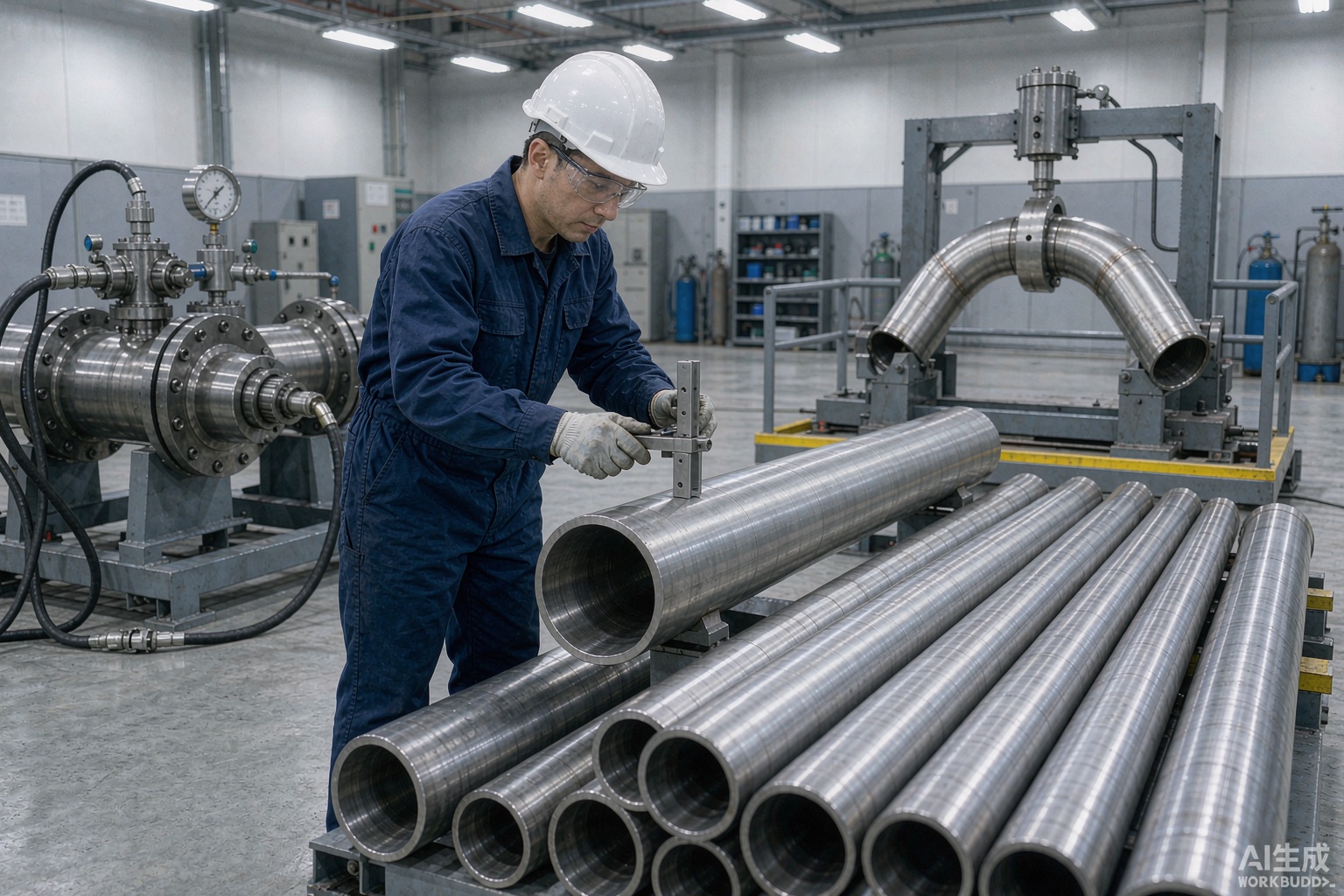
Short answer: a nickel alloy tube or pipe is not accepted by its grade name alone — it is accepted by the tests it passes, and the tests worth specifying are bend, flattening, flare, hydrostatic, plus surface NDT (eddy current or UT). This guide lists the acceptance tests that actually catch a bad lot, explains what each one reveals about the material, and gives the purchase-order wording that makes a failed test the supplier's problem instead of a silent risk in your system.
Tube and pipe fail in ways bar and plate do not, because the product is a thin-walled pressure boundary. A laps seam that a bar would shrug off becomes a through-wall leak in a heat-exchanger tube; a wall that is a few percent thin becomes a burst in a hydrostatic proof. The only way to know is to test the lot you received, against the standard you specified, and to write those tests into the order before you pay.
Our route runs from a 100% virgin prime melt through VIM and ESR or VIM and VAR, complete oxide-scale removal, and the specified solution anneal or age, so every tube we ship carries a hydrostatic and NDT result that matches the heat it left the mill with, not a number borrowed from a different lot.
Short answer: acceptance tests are the buyer's only proof that the pressure boundary you bought is sound, because chemistry and dimensions on the certificate say nothing about whether a seam will open under pressure.
A mill test certificate tells you the alloy is the right chemistry and the wall is the right size. It does not tell you whether a longitudinal lap is hiding under the surface, whether the weld line in an welded tube is sound, or whether the tube will split on the first bend. Those questions are answered only by destructive and non-destructive acceptance tests performed on the lot.
For seamless nickel alloy pipe made from a single pierced billet the risk profile differs from welded tube, but both need proof that the wall is continuous and the metal is ductile. Heat-exchanger tubing in particular lives or dies on surface quality and wall integrity, because a single leaker takes a whole bundle offline.
A second reason acceptance testing gets skipped is that it costs the supplier time and scrap. A flattening test destroys a sample length, and a hydrostatic proof ties up the line, so a supplier bidding low will quietly drop the tests the order never named and ship a certificate with a vague "tested" stamp that covers none of them. The buyer who writes the tests into the purchase order, with a reject-and-replace clause, removes that temptation before it starts rather than discovering a bad lot at the receiving dock.
Short answer: the standard battery is flattening (or reverse flattening), flare, bend, hydrostatic, and surface NDT by eddy current or ultrasonic — pick the set that matches how the tube is made and how it will be used.
| Test | What it proves | Typical standard | When to require it |
|---|---|---|---|
| Flattening | No laps, seams or inclusions open under radial compression | ASTM E276 / product spec | Every seamless tube and pipe |
| Reverse flattening | Weld line integrity in welded tube | Product spec for welded | Welded nickel alloy tube |
| Flare | Ductility and freedom from surface defects at the end | ASTM E191 / product spec | Tubes that will be flared or expanded |
| Bend | Ductility and soundness through a controlled bend | ASTM E190 | Formed or bent service |
| Hydrostatic | Wall holds design pressure without leaking | Product specification | Pressure pipe and pressure tubing |
| Eddy current / UT | Surface or volumetric defects caught without destroying the tube | ASTM E309 / E213 | All tubing where leaks are costly |
Short answer: each acceptance test is tuned to a specific failure mode — a flattening test finds laps, a hydrostatic test finds thin wall, eddy current finds surface seams — so skipping one test leaves exactly that failure mode undetected.
| Failure mode | Root cause | Symptom in service | Test that catches it | How to prevent it |
|---|---|---|---|---|
| Longitudinal lap / seam | Inclusion or fold from piercing or rolling | Through-wall leak on first cycle | Flattening + eddy current | Require both; reject on any opening |
| Thin wall | Out-of-tolerance mandrel or skim pass | Burst below design pressure | Hydrostatic proof at 1.5x design | Specify hydrostatic pressure in PO |
| Weld-line defect | Lack of fusion in welded tube | Crack along the weld | Reverse flattening + UT | Require welded-tube weld NDT |
| Brittle end | Cold work or contamination at the end | Split when flared | Flare test | Require flare on expanded tubes |
| Hidden crack | Processing crack not on surface | Delayed failure under load | UT (volumetric) | Require UT where leaks are costly |
Short answer: eddy current sees surface and near-surface seams on a moving tube and is the workhorse for heat-exchanger tubing; ultrasonic testing sees volumetric flaws and is the choice where wall-thickness loss or internal defects would be catastrophic.
Eddy current (ASTM E309) runs the whole length of the tube at speed and flags surface-breaking and shallow subsurface defects, which is exactly what ruins a heat-exchanger bundle. Ultrasonic testing (ASTM E213) sends a sound beam into the wall and detects inclusions or wall loss anywhere through the thickness, which matters for pressure tubing where a deep flaw is the leak.
Neither replaces the other. A tube that passes eddy current can still hide a volumetric inclusion that only UT finds, and a tube that passes UT can still carry a surface lap that only eddy current catches. For sour-gas and downhole tubing where a failure is a safety event, specify both, and tie the acceptance to NACE MR0175 / ISO 15156 hardness and testing limits.
The usefulness of NDT depends entirely on the acceptance level written into the order. Eddy current is calibrated against a reference notch of a stated depth and phase, and if the PO does not state the notch depth and the reject threshold, the supplier can run a loose setting that passes seams a tighter setting would flag. The same holds for UT, where the gate and sensitivity decide what counts as a defect. Always name the calibration standard and the rejection level, not merely "NDT per ASTM E309," because the unqualified phrase lets the supplier choose the easiest setting that still satisfies the letter of the order.
Short answer: name the product specification, the exact tests, the acceptance criterion for each (for example 1.5x design hydrostatic, no opening on flattening), and a reject-and-replace clause so a failed lot costs the supplier, not you.
A purchase order that says "per ASTM B829" without naming the tests leaves the supplier free to run the cheapest subset. Spell out the battery: flattening, flare, bend, hydrostatic at a stated pressure, and eddy current or UT to a stated calibration. State the reject criterion in measurable terms — "no crack shall initiate during flattening to the specified gap" — so the result is pass or fail, not an opinion.
Also require that test results be reported per heat and per lot on the certificate, and that any tube that fails be removed and replaced at the supplier's cost before shipment. When the tube will be welded into the system, ask for the same NDT discipline you would apply to the welding procedure, because the joint is only as sound as the parent tube.
Short answer: the product specifications (ASTM B829, B626, B444, B423, B668 and siblings) name the tests; the methods (ASTM E190, E276, E309, E213) describe how to run them; the PO is where you make them mandatory.
| Document | Role | Use |
|---|---|---|
| ASTM B829 / B626 / B444 etc. | Product specifications | Name the grade, form and required tests |
| ASTM E190 | Guided bend test | Prove ductility and soundness |
| ASTM E276 | Flattening test | Reveal laps and seams under compression |
| ASTM E309 | Eddy-current examination | Surface defect scan of tubing |
| ASTM E213 | Ultrasonic examination | Volumetric defect scan of tubing |
| NACE MR0175 / ISO 15156 | Sour-service limits | Hardness and test limits for H2S |
Short answer: before you accept the lot, confirm the PO named the tests, the certificate reports each one per heat, the hydrostatic pressure matches 1.5x design, and NDT was done to the calibration you specified.
| Check | Pass criterion |
|---|---|
| Tests named in PO | Bend, flatten, flare, hydrostatic, NDT all listed |
| Results per heat | Each test reported against the heat number |
| Hydrostatic pressure | At or above 1.5x design pressure |
| NDT calibration | Eddy current or UT to stated standard and level |
| Reject clause | Failed tube removed and replaced at supplier cost |
| Sour service | NACE limits met where H2S applies |
At minimum, flattening and a surface NDT (eddy current or ultrasonic) for seamless tubing, with flare and bend added where the tube will be expanded or formed, and a hydrostatic proof for anything that holds pressure. Welded tube also needs reverse flattening and weld-line NDT. The exact battery should be written into the purchase order, not left to the supplier's default.
No. A hydrostatic proof confirms the wall holds pressure at the test level, but it will not reveal a surface lap, a near-surface seam or a volumetric inclusion that has not yet opened. Those are caught only by flattening and NDT, which is why a hydrostatic pass with no NDT still lets defective tubing into service.
Use eddy current for surface and near-surface defects on heat-exchanger tubing, and ultrasonic testing where wall loss or internal defects would be catastrophic. For high-consequence service such as sour gas, specify both, because each sees a different class of flaw and neither covers the other's blind spot.
No. "Tested" with no per-heat result and no acceptance criterion is not acceptance evidence; it is a claim. Require the actual result for each test against the heat number and a stated pass/fail limit, so you can reconcile the test to the lot you received rather than trusting a word.
Yes. Welded tube must prove the weld line is sound, so reverse flattening and weld-line UT or radiography belong in the battery, whereas seamless tube relies on flattening and NDT to expose pierced-billet laps. The product specification (for example the welded-tube variant) tells you which weld tests apply, and the PO should name them explicitly.
A common proof is 1.5 times the design pressure of the system the tube serves, held for a defined time with no leakage. State the number in the PO rather than accepting a generic "hydrostatically tested" note, because without a pressure and a hold time the test proves almost nothing.
You do, unless the purchase order says otherwise. That is why the PO must include a reject-and-replace clause: any tube that fails the named tests is removed and replaced at the supplier's cost before shipment. Without that clause, a failed lot becomes your rework and your downtime.
If your current supplier ships nickel alloy tube or pipe with a vague "tested" note and no per-heat results, tell us the grade, UNS, outside diameter, wall and service. We will quote tube and pipe with the full acceptance battery written into the order — flattening, flare, bend, hydrostatic at your design pressure, and eddy current or UT to the level you specify — with every result reported against the heat number so the proof matches the lot you receive.
Email: serena@hangboalloy.com
Phone: +86 166 2109 2936
WhatsApp: +86 166 2109 2936
Send us the grade and UNS, the outside diameter, wall and length, and the service pressure. We will quote tube and pipe with the full acceptance battery written into the order, flattening, flare, bend, hydrostatic at your design pressure, and eddy current or UT to the level you specify, every result reported against the heat number so the proof matches the lot you receive.