
Hangbo Alloy Group
Shanghai · Est. 2012
UNS N06022 in plate, sheet, seamless tube, bar, forgings and welded pipe — a Ni-Cr-Mo-W alloy built for mixed acids, oxidising chlorides and flue gas desulphurisation duty, supplied with full EN 10204 3.1 traceability.
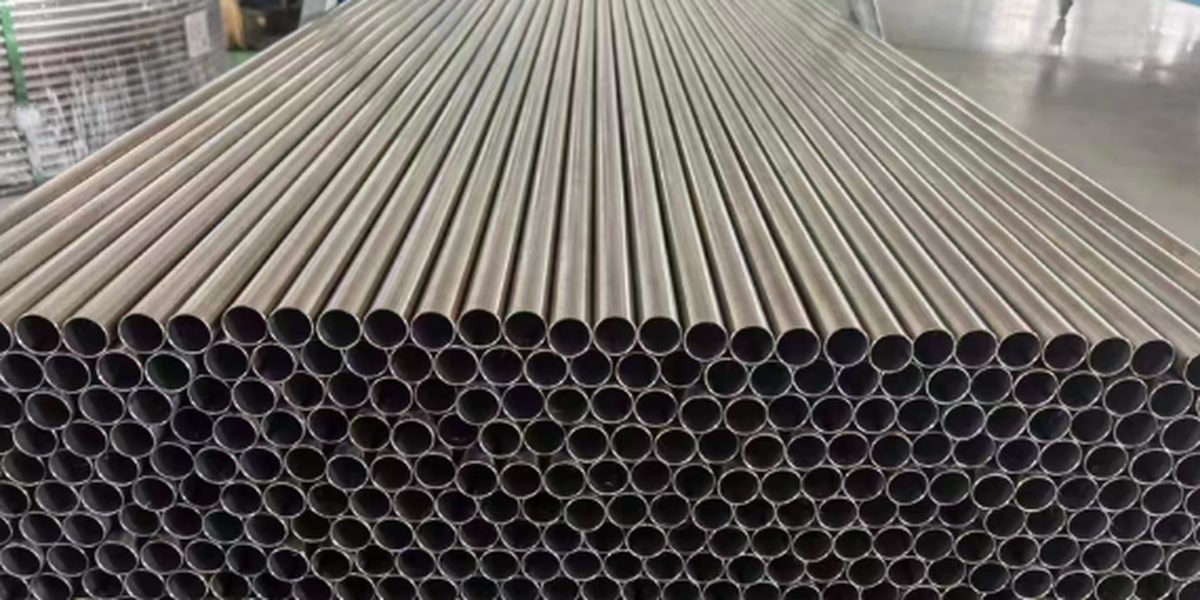
Hastelloy C22 (UNS N06022, Werkstoff 2.4602) is the most broadly corrosion-resistant member of the Ni-Cr-Mo family. Its nominal chemistry — nickel balance, 20.0–22.5% chromium, 12.5–14.5% molybdenum, 2.5–3.5% tungsten and 2.0–6.0% iron, with carbon held to 0.015% maximum — delivers a pitting resistance equivalent number in the mid-60s while remaining thermally stable enough to weld without sensitisation in most practical thicknesses. That combination is why C22 is specified where the process stream changes composition: mixed acid pickling lines, pharmaceutical multipurpose reactors, flue gas desulphurisation absorbers and sour gas wellhead components.
Hangbo Alloy supplies C22 in every primary wrought form from a single melt route, which matters because weldability and corrosion performance are sensitive to trace elements. Compared with C276, the higher chromium and controlled tungsten content of C22 gives measurably better resistance to oxidising media and to localised attack in chloride-bearing oxidising environments, while retaining the reducing-acid performance expected of a high-molybdenum grade. See our comparison of Hastelloy C276 vs C22 corrosion behaviour for the full breakdown.
Material is delivered solution annealed at 1120–1170 °C and water quenched, then descaled and pickled or bright finished depending on form. Every heat is identifiable by melt number through to the finished piece, and we can supply the original mill certificate or issue our own EN 10204 3.1 document against the actual shipped heat.
C22 is covered by a complete set of ASTM and ASME product specifications, and we hold stock or rolling programmes against each of them:
Also available against NACE MR0175 / ISO 15156 for sour service, and to ASME Section II Part B design values for coded vessels. Where a customer specification imposes tighter residual element limits — for example vanadium or cobalt caps for nuclear-adjacent work — we can source against a modified chemistry.
Typical delivered analysis sits at nickel balance, chromium 21%, molybdenum 13.5%, tungsten 3%, iron 4%, with cobalt limited to 2.5% maximum, manganese 0.5%, vanadium 0.35%, silicon 0.08%, phosphorus 0.02% and sulphur 0.02%. The low carbon and silicon figures are deliberate: they keep the heat-affected zone free of the grain-boundary precipitation that causes intergranular attack after welding, which is the dominant failure mode for C276 in oxidising chloride service.
For welding, matching composition filler ERNiCrMo-10 (AWS A5.14) is standard, with GTAW preferred for root passes and GMAW or SAW for fill on thicker sections. Preheat is not normally required and interpass temperature should be held below 120 °C. C22 is routinely welded to carbon steel and to stainless steel using ERNiCrMo-3 or ERNiCr-3 buttering where dilution control is needed.
Machining C22 follows the same rules as other nickel-base corrosion alloys: rigid setup, positive rake, constant feed and no dwelling. Carbide tools at surface speeds around 15–25 m/min for turning with soluble oil or neat cutting oil give predictable tool life. Work hardening is rapid, so depths of cut should stay above the previously work-hardened layer. Our machining guide for nickel alloys covers tooling and parameters in detail, and CNC machined parts to drawing can be delivered finished rather than as raw stock.
Every shipment leaves with a certificate referencing the applicable ASTM edition, the heat number, the heat treatment condition and the measured mechanical and chemical values. Tensile testing follows ASTM E8/E8M, hardness ASTM E18 or E10, and chemical analysis is verified by optical emission spectrometry or wet methods with a calibrated reference standard.
Non-destructive examination is available to the level the service requires: ultrasonic testing to ASTM B829 supplementary requirements or ASME Section V Article 4, dye penetrant to ASTM E165, radiography where specified, and hydrostatic or eddy current testing to ASTM B829. Intergranular corrosion testing to ASTM G28 Method A can be quoted on request for critical welded fabrications.
Hangbo Alloy operates under ISO 9001:2015, GJB 9001C and GOST R certification. Third-party inspection is arranged through BV, SGS, TÜV, DNV or Lloyd's Register when the purchase order calls for it, including witness of mechanical testing and review of the melt documentation. Heat numbers are stamped or etched on plate and bar and transferred to the packing list so traceability survives cutting and fabrication.
Standard packing is export seaworthy: plate on timber pallets with interleaved protection, tube in end-capped bundles, bar in strapped lifts, all with VCI paper and desiccant. Documentation packages can include the certificate of origin, packing list, test certificate and a certified translation where the destination authority requires it.
C22 carries higher chromium (20.0–22.5% versus 14.5–16.5%) and adds 2.5–3.5% tungsten, which gives it better resistance to oxidising media, oxidising chlorides and localised pitting. C276 remains excellent in reducing acids and is often the lower-cost choice where the stream is consistently reducing. Where the process alternates between oxidising and reducing conditions, C22 is normally the safer single-material specification.
Plate, sheet and strip are covered by ASTM B575 / ASME SB575; seamless pipe and tube by ASTM B622 / ASME SB622; welded pipe by ASTM B619 and welded tube by ASTM B626; rod, bar and wire by ASTM B574 / ASME SB574; forgings by ASTM B564 / ASME SB564; and wrought fittings by ASTM B366.
Plate is supplied from 0.5 mm to 60 mm thick in widths to 2000 mm and lengths to 6000 mm, cut to drawing where required. Seamless tube to ASTM B622 runs from 6 mm to 219 mm outside diameter with wall thickness from 0.5 mm to 20 mm. Round bar is available from 6 mm to 300 mm diameter. Sizes outside these ranges can be produced against a rolling or drawing programme.
Send us your grade, diameter, length, quantity, and any special requirements. Our team responds within 10 minutes during business hours.