
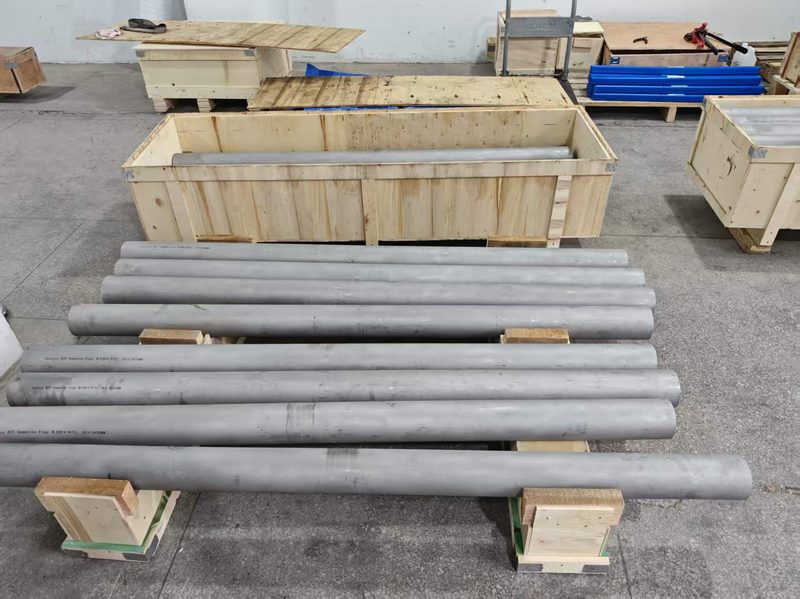
Overview
Hastelloy C-276 (UNS N10276) and Hastelloy C-22 (UNS N06022) are both nickel-chromium-molybdenum corrosion-resistant alloys developed for the most aggressive chemical environments. While C-276 has been the industry standard for decades, C-22 represents a metallurgical evolution with higher chromium and optimized tungsten content, offering superior performance in oxidizing chloride media and crevice corrosion conditions.
Chemical Composition
| Element | Hastelloy C-276 (N10276) | Hastelloy C-22 (N06022) |
|---|---|---|
| Nickel (Ni) | ≥ 57% (Balance) | ≥ 56% (Balance) |
| Chromium (Cr) | 14.5–16.5% | 20.0–22.5% |
| Molybdenum (Mo) | 15.0–17.0% | 12.5–14.5% |
| Tungsten (W) | 3.0–4.5% | 2.5–3.5% |
| Iron (Fe) | 4.0–7.0% | 2.0–6.0% |
| Carbon (C) | ≤ 0.01% | ≤ 0.01% |
| Density | 8.89 g/cm³ | 8.61 g/cm³ |
The critical difference: C-22 contains significantly more chromium (+6%) and less molybdenum (−3%), shifting its corrosion optimum from reducing to oxidizing chloride environments.
Crevice Corrosion — The CCT Advantage
Hastelloy C-22 significantly outperforms C-276 in crevice corrosion resistance per ASTM G48 testing:
- C-22 CCT (Critical Crevice Temperature): ≈ 120°C
- C-276 CCT: ≈ 85°C
The 35°C advantage is attributed to C-22's higher chromium content, which forms a more stable and repairable Cr₂O₃ passive film in tight crevices and under deposits.
Wet Chlorine Performance
Hastelloy C-22 demonstrates superior resistance in wet chlorine (Cl₂) and hypochlorous acid (HClO) environments. The higher chromium content (22% vs 16%) forms a more stable passive oxide layer in oxidizing chloride media. C-276 remains excellent in reducing chloride environments (HCl), but C-22 extends performance into the oxidizing chloride regime.
ASTM Product Standards
| Product Form | C-276 | C-22 |
|---|---|---|
| Sheet/Plate | ASTM B575 | |
| Seamless Tube | ASTM B622 | |
| Welded Tube | ASTM B619 | |
| Bar | ASTM B574 | |
| Russian Analog | ХН65МВУ (NS3304) | ХН70МВ-ВИ (NS3308) |
Weldability
Both alloys exhibit excellent weldability without post-weld heat treatment requirements. Their ultra-low carbon content (≤ 0.01%) virtually eliminates carbide precipitation in the HAZ.
- C-276: ERNiCrMo-4 filler metal
- C-22: ERNiCrMo-10 filler metal
C-22 welded joints generally show better corrosion resistance in the HAZ — ASTM G28A tests show corrosion rates < 0.05 mm/year for as-welded C-22 versus < 0.10 mm/year for C-276.
Maximum Service Temperature
For corrosion service, both alloys are recommended to 400°C for continuous operation. Above 600°C, secondary phase precipitation (μ-phase, P-phase) begins, degrading corrosion resistance. For high-temperature strength applications, C-276 can operate to 1090°C in oxidizing conditions, though corrosion resistance degrades.
Cost Comparison
Hastelloy C-22 is typically 15–25% more expensive than C-276 due to higher chromium (22% vs 16%) and tungsten optimization. However, total cost of ownership may favor C-22 in wet chlorine and high-temperature crevice conditions due to longer service life and fewer replacements.
Selection Guide
- Reducing acid service (HCl)? → Either, C-276 marginally better
- Wet chlorine, hypochlorite, oxidizing chlorides? → C-22 (higher Cr)
- Tight crevice, under-deposit conditions? → C-22 (CCT ~120°C)
- Weld overlay on dissimilar metals? → C-276 (traditional choice)
- General chemical plant, both reducing and oxidizing? → C-22 (wider envelope)
Fabrication and Welding Comparison
Both alloys are readily weldable, and both were designed to resist weld heat-affected-zone attack — the property that separated them from the earlier C-grade Hastelloys. The practical differences are in filler choice and thermal stability.
| Aspect | Hastelloy C-276 | Hastelloy C-22 |
|---|---|---|
| Common filler | ERNiCrMo-4 | ERNiCrMo-10 |
| Weld HAZ resistance | Excellent (low C, low Si) | Excellent (low C, low Si) |
| Thermal stability | Sensitive to 550–1050 °C exposure | More tolerant of intermediate temperatures |
| Post-weld heat treatment | Not normally required | Not normally required |
| Max service temperature | ≈ 1040 °C | ≈ 1040 °C |
C-22's greater tolerance of intermediate-temperature exposure makes it the safer choice where the fabrication route includes multiple thermal cycles. See also Hastelloy C-276 composition data.
Frequently Asked Questions
Is C-22 simply a better C-276?
Not universally. C-22 is more resistant to pitting and crevice corrosion and is more thermally stable, but C-276 is usually more economical and performs better in some strongly reducing acid environments. Match the alloy to the specific chemistry.
Can I weld C-276 with C-22 filler?
Yes — over-alloyed fillers are common practice and generally acceptable. The usual convention is to use the filler matching the more highly alloyed base material.
Which is better for flue-gas desulphurisation?
C-22 in most modern FGD absorbers, because the environment is oxidising with high chloride content. C-276 remains common in older installations and in strongly reducing process streams.