
Hangbo Alloy Group
Shanghai · Est. 2012
Continuous-coil nickel alloy wire rod for drawing, cold heading, weaving and re-rolling, produced under a documented melt-to-coil traceability chain.
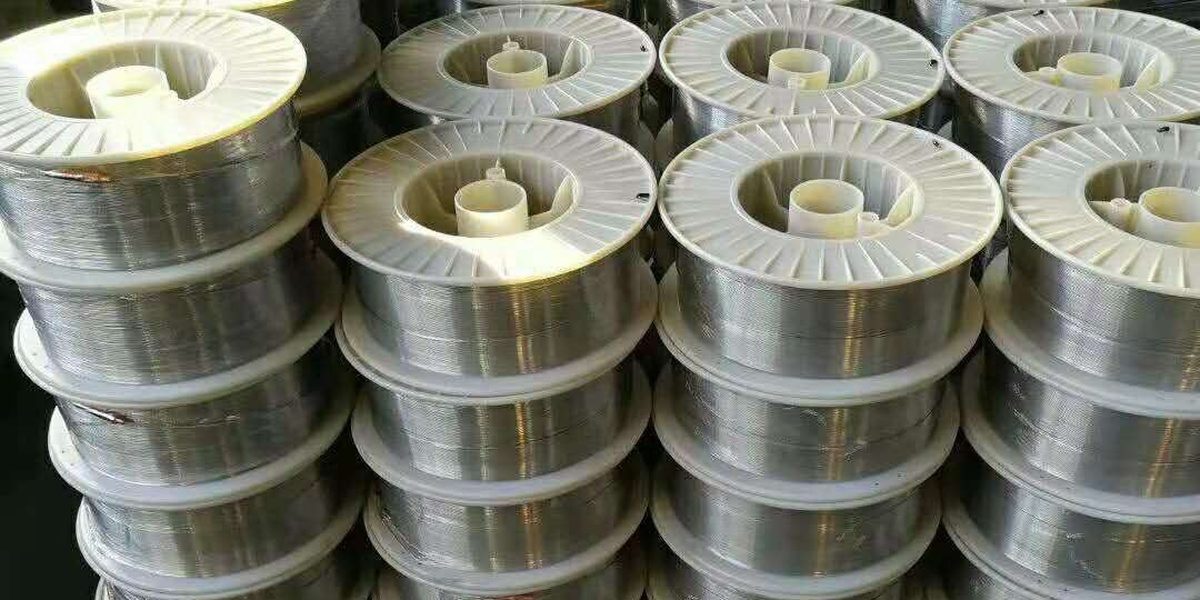
Nickel alloy wire rod is the coiled intermediate stock that downstream converters draw into fine wire, head into fasteners, weave into mesh, wind into springs or re-roll into narrow strip. Shanghai Hangbo Alloy Group supplies hot-rolled, annealed and descaled nickel alloy wire rod in continuous coils from 5.5 mm to 20.0 mm diameter, rolled on a controlled-cooling rod mill and delivered with an unbroken melt-to-coil traceability record. Because the product is coiled rather than cut into straight lengths, converters can run long uninterrupted drawing campaigns with fewer stop-welds and far less end scrap than straight bar produces.
Wire rod is often confused with finished welding wire, but the two are distinct products at different points in the value chain. Rod is the feedstock: it still has mill scale or a pickled surface, a hot-rolled tolerance band, and no filler metal classification. Nickel alloy welding wire, by contrast, has already been drawn to final diameter, cleaned, spooled and qualified to an AWS A5.14 classification such as ERNiCrMo-3 or ERNiCr-3. If your process begins with a draw bench, a heading machine or a loom, rod is the correct and more economical purchase; if it begins at a torch or an automated spool, buy the finished wire instead.
Typical end uses we supply into include fastener and stud manufacturing, welding consumable production, woven and knitted mesh for filtration and catalyst support, spring wire, wire rope and cable armour, and cold-drawn bar conversion. Most of our rod leaves the mill in the solution-annealed condition so that the converter can apply its own final thermal treatment after cold work.
Hot-rolled coil, as-rolled or annealed and pickled. The standard supply form, 5.5 mm to 20.0 mm diameter. As-rolled coil retains a tightly adherent oxide and suits converters who pickle or blast in-house; annealed-and-pickled coil arrives bright enough to go straight onto a draw bench or shot-blast line. We can also supply mechanically descaled and pickled rod where residual surface oxide would shorten die life.
Drawn, peeled or centreless-ground coil. Where the drawing schedule starts below the hot-rolled tolerance band, we supply rod that has been drawn one or two passes, or peeled and centreless-ground to ISO 286 h9 or h10 before coiling. This removes decarburised and seam-affected surface layers and materially reduces the number of intermediate anneals the converter needs.
Dimensions and coil parameters. Standard diameters 5.5, 6.5, 8.0, 9.5, 10.5, 12.0, 14.0, 16.0 and 20.0 mm, with intermediate sizes on request. Hot-rolled diameter tolerance is typically ±0.30 mm with ovality held within the applicable ASTM table; ground rod is held to h9 or h10. Coils are spiral-wound at 500 to 1500 kg, 800 to 1250 mm inside diameter and 1200 to 1600 mm outside diameter, compacted and strapped for export, with an option of individual coil tagging carrying heat number, grade, size and weight.
Our rod programme covers the full commercial nickel family rather than a single alloy. Commercially pure grades Nickel 200 and Nickel 201 serve caustic and electronics applications. Monel 400 and Monel K-500 cover marine, pump and valve trim. Inconel 600 and 601 dominate furnace and heat-treatment fixture manufacture, while Inconel 625 is the workhorse for corrosion-service wire - see our detailed note on Inconel 625 wire applications.
For fastener converters, the age-hardenable grades matter most. Inconel 718, Inconel X-750 and A-286 are supplied in the solution-annealed or annealed-and-cold-drawn condition so the fastener maker can head and roll threads before applying the final ageing cycle; the metallurgy behind that step is described in our guide to precipitation strengthening in nickel superalloys. Rod destined for oil and gas bolting is produced and certified to NACE MR0175 / ISO 15156 hardness and heat-treatment requirements.
We also roll Incoloy 800, 825 and 925, Hastelloy B-2, B-3, C276 and C22, Alloy 20 and Alloy 330. Grades outside this list can be produced against a customer specification or a recognised national equivalent provided the melt size is economical.
Melting starts from virgin charge plus controlled revert, in electric arc furnace with argon-oxygen decarburisation, or by vacuum induction melting followed by electroslag remelting or vacuum arc remelting where the end use demands it - aerospace rotating parts, nuclear and deep sour service among them. The ingot or billet is conditioned, reheated under a controlled atmosphere and rolled on the rod mill with controlled cooling on the run-out table, which sets a uniform, drawable grain structure and limits the scale thickness the converter has to remove.
Solution annealing follows in a continuous or batch furnace with calibrated, recorded temperature profiles. Rod is then pickled in mixed acid, neutralised and dried, inspected by eddy current for seams and laps, and - for remelted grades - ultrasonically tested. Converters requiring a bright start surface receive an additional peel or centreless-grind pass with 100% surface inspection.
Every coil is identified to a single heat and heat-lot. Documentation is issued to EN 10204 3.1 as standard, and to EN 10204 3.2 with independent witness on request. Our quality system is certified to ISO 9001:2015, and we also hold GJB 9001C and GOST R approvals. Third-party inspection can be arranged through BV, SGS, TUV, DNV or Lloyd's Register, typically covering dimensional check, tensile and hardness, positive material identification, grain size to ASTM E112, and where specified intergranular corrosion testing to ASTM G28. Test coupons are retained from the same heat lot for the period agreed in the purchase order.
For stocked grades such as Inconel 625, Inconel 718 and Monel 400 we can split a coil down to roughly 300 kg and still supply full certification against the original heat. For made-to-order grades the practical minimum is one melt, generally one to three tonnes depending on alloy, because the melt and rolling campaign cannot be economically split below that. Trial quantities are quoted on a per-kilogram basis that reflects the shorter run.
Both. Hot-rolled annealed-and-pickled coil is the default and the cheapest option. Where your first die is close to the hot-rolled tolerance band, or where seams and decarburisation would shorten die life, we recommend a drawn, peeled or centreless-ground start at h9 or h10. Ground rod costs more per kilogram but usually pays for itself through higher die life, fewer intermediate anneals and better surface finish on the finished wire.
Yes. EN 10204 3.2 certification with independent witness is routinely arranged through BV, SGS, TUV, DNV or Lloyd's Register, and we also work with client-nominated inspectors. Witnessed testing normally covers chemical analysis with PMI verification, tensile and hardness, dimensional and surface inspection, and any supplementary test the specification calls for such as ASTM G28 intergranular corrosion or ASTM E112 grain size. Please nominate the inspection agency at enquiry stage so the hold points can be built into the production schedule.
Send us your grade, diameter, length, quantity, and any special requirements. Our team responds within 10 minutes during business hours.