
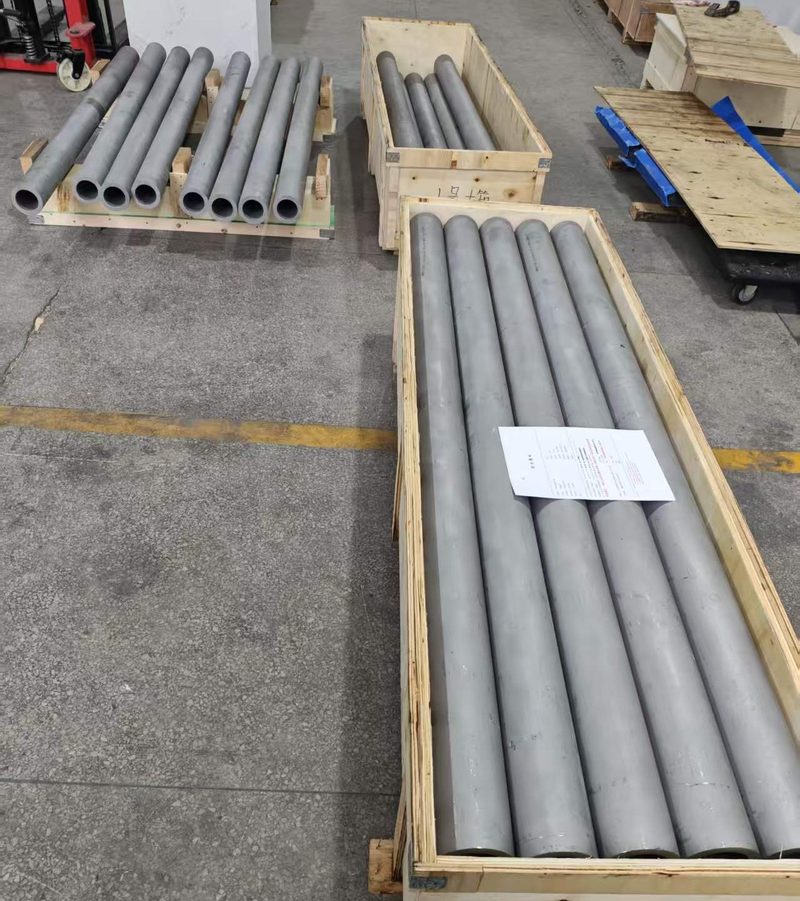
Overview
Inconel 625 (UNS N06625) and Incoloy 825 (UNS N08825) are both nickel-based alloys widely used in chemical processing. The key distinction: Inconel 625 contains significantly more nickel (≥58%), molybdenum (8–10%), and niobium, making it a high-performance corrosion and oxidation-resistant alloy. Incoloy 825 adds copper and titanium at a lower nickel level (38–46%), optimized for sulfuric acid resistance at a more economical cost.
Chemical Composition Comparison
| Element | Inconel 625 (N06625) | Incoloy 825 (N08825) |
|---|---|---|
| Nickel (Ni) | ≥ 58% | 38–46% |
| Chromium (Cr) | 20–23% | 19.5–23.5% |
| Molybdenum (Mo) | 8–10% | 2.5–3.5% |
| Iron (Fe) | ≤ 5% | ~30% (balance) |
| Niobium (Nb) | 3.15–4.15% | — |
| Copper (Cu) | — | 1.5–3.0% |
| Titanium (Ti) | — | 0.6–1.2% |
PREN and Pitting Resistance
- Inconel 625: PREN ≈ 51–54 (Cr~21, Mo~9)
- Incoloy 825: PREN ≈ 29–33 (Cr~21.5, Mo~3)
With nearly double the PREN value, Inconel 625 offers dramatically superior resistance to pitting and crevice corrosion in chloride-rich environments such as seawater, FGD scrubbers, and offshore applications.
Mechanical Properties (Room Temperature, Annealed)
| Property | Inconel 625 | Incoloy 825 |
|---|---|---|
| Tensile Strength | ≥ 827 MPa | ≥ 586 MPa |
| Yield Strength | ≥ 414 MPa | ≥ 241 MPa |
| Elongation | ≥ 30% | ≥ 30% |
| Density | 8.44 g/cm³ | 8.14 g/cm³ |
Inconel 625 is significantly stronger due to solid-solution strengthening from its high molybdenum and niobium content.
ASTM Standards
| Product Form | Inconel 625 | Incoloy 825 |
|---|---|---|
| Sheet/Plate | ASTM B443 | ASTM B424 |
| Seamless Tube | ASTM B444 | ASTM B163 |
| Bar | ASTM B446 | ASTM B425 |
| Forgings | ASTM B564 | ASTM B564 |
Weldability
Both alloys offer excellent weldability. Inconel 625 has outstanding resistance to hot cracking due to niobium stabilization, making it the preferred weld overlay alloy. Neither requires post-weld heat treatment for corrosion resistance.
Cost Comparison
Inconel 625 typically costs 1.5–2 times more than Incoloy 825 per kilogram, driven by higher nickel (≥58% vs 38–46%) and molybdenum (8–10% vs 2.5–3.5%) content. Approximate pricing:
- Inconel 625: $25–40/kg for standard tubes and sheets
- Incoloy 825: $12–20/kg for standard tubes and sheets
Selection Guide
- Seawater, offshore, FGD scrubbers, high chloride? → Inconel 625 (PREN > 50)
- Sulfuric acid, moderate concentration, moderate temperature? → Incoloy 825 (Cu provides H₂SO₄ resistance)
- High strength required at elevated temperature? → Inconel 625
- Budget-limited, mild chloride environment? → Incoloy 825
- Sour gas (NACE MR0175)? → Inconel 625 preferred
Fabrication and Welding Comparison
Both alloys weld readily, but the filler choice and post-weld behaviour differ enough to influence a fabrication quote.
| Aspect | Inconel 625 (N06625) | Incoloy 825 (N08825) |
|---|---|---|
| Common filler | ERNiCrMo-3 (625) | ERNiCrMo-3 or ERNiFeCr-1 |
| Preheat | Not required | Not required |
| Interpass limit | ≤ 150 °C | ≤ 150 °C |
| PWHT | Rarely needed | Stabilising anneal 940 °C sometimes specified |
| Machining | Harder, more tool wear | Machines more like austenitic stainless |
| Dissimilar welding to carbon steel | Excellent, standard practice | Good |
Practical summary: 625 is more forgiving in welding and cladding, while 825 is more economical and easier to machine. Guidance on cutting parameters is in our machining guide.
Frequently Asked Questions
Which is more cost-effective for a chemical process vessel?
Incoloy 825, usually by a significant margin — it contains roughly 20 % less nickel with comparable resistance to sulphuric and phosphoric acid. Specify 625 where chloride pitting, seawater or higher strength governs the design.
Can 625 replace 825 in sulphuric acid service?
Yes, and it will generally last longer, but it is rarely the economical answer unless the duty also involves chlorides or requires the higher allowable stress.
Is either alloy suitable for sour (H₂S) service?
Both are used in sour service, but the required heat treatment and hardness limits must be met. Check our NACE MR0175 guidance before ordering.