
Hangbo Alloy Group
Shanghai · Est. 2012
Hot-finished bar is rough, cheap and stress-free; cold-drawn bar is bright, tight and may carry locked-in stress that warps it when machined. This guide compares the two routes and tells you which to specify for machining, polishing and critical service.
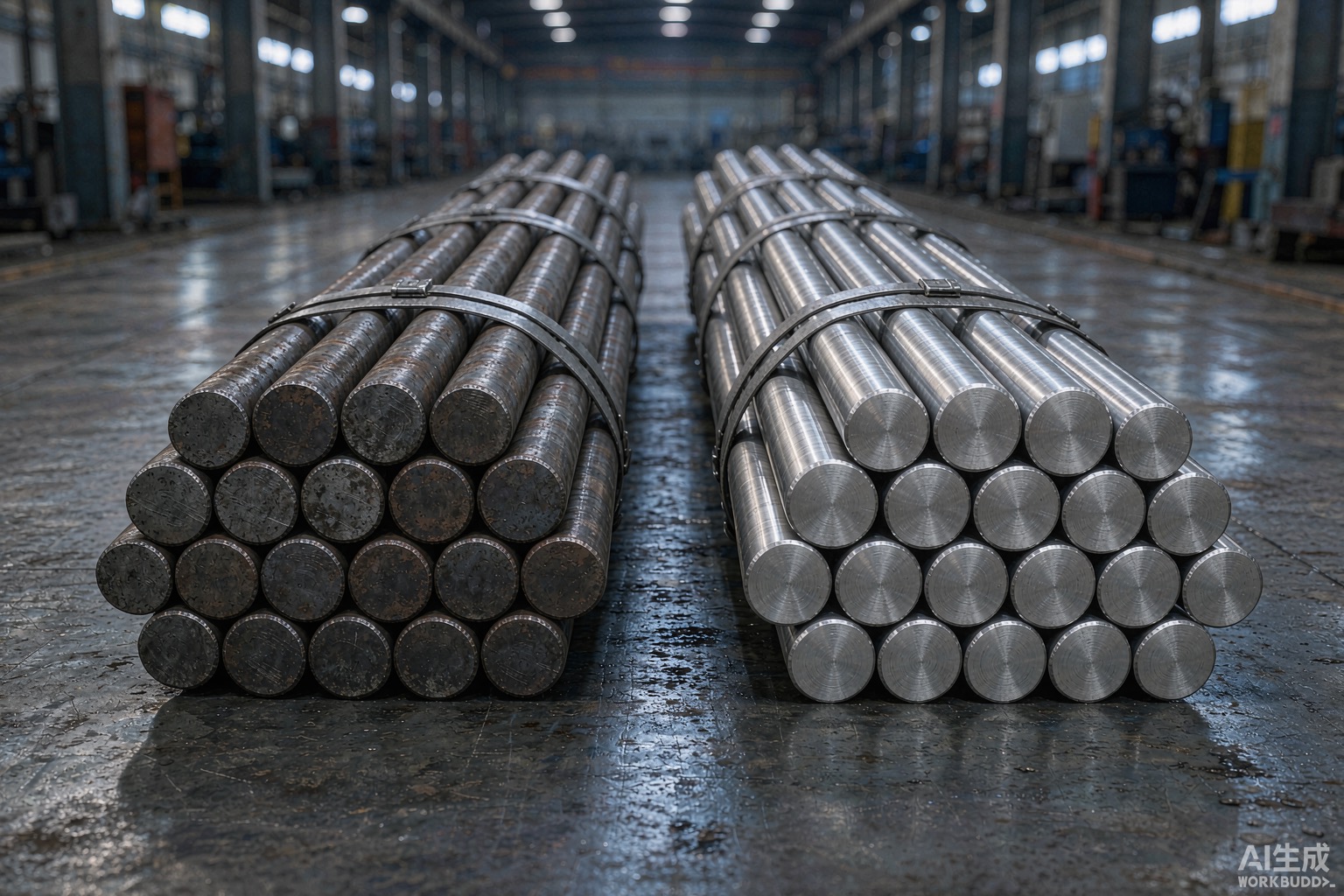
Short answer: hot-finished bar is shaped warm, so it is rough and out of tolerance but carries almost no locked-in stress, while cold-drawn bar is pulled through a die when cold, so it is bright, dimensionally tight and straight but stores residual stress that can warp it when you machine — the right choice depends on whether you need a clean surface and tight size, or a stable part that will not move on the lathe. Buyers who order “bar” without naming the route often get the cheap hot-finished kind when they needed a precision blank, or pay for cold-drawn they then have to anneal anyway.
This guide compares the two production routes on the properties that actually decide a job — surface, tolerance, straightness and residual stress — and gives a decision table for when to specify each. The route question sits inside the broader material-integrity picture in our complete nickel alloy procurement pitfalls guide, but the finish-versus-stability trade-off is specific enough to deserve its own treatment.
We are a Shanghai nickel alloy manufacturer, so the comparison below reflects what our own shop actually produces and what we record on the heat-treatment and inspection documents; use it as a specification aid, not as a replacement for the certificate on the lot you receive. If you tell us the machining sequence, we will recommend the route and the relief step that keeps your part stable.
Short answer: the route is set at the very last forming step — hot rolling or forging for hot-finished, cold drawing or cold peeling for cold-finished — and that single choice fixes the surface, the achievable tolerance, the straightness and above all how much residual stress the bar carries, so it has to be specified, not assumed.
A hot-finished bar leaves the mill warm and is air-cooled; it keeps the scale from rolling and a tolerance measured in millimetres, but it is metallurgically calm. A cold-drawn bar is pulled through a die at room temperature to pull it round and tight; that cold deformation is what gives the bright surface and the close size, and it is also what stores the stress. You cannot get a mirror-bright, tenth-tolerance bar without cold work, and you cannot do cold work without stress — unless a thermal cycle is added afterward. That is the whole trade-off in one sentence.
This matters because the two routes are not priced or delivered the same way, and a quotation that does not name the route is a quotation you cannot fully compare. The route also drives how you should plan machining and whether the bar needs relief before you cut, which is why we link the two topics rather than treating finish as cosmetic.
Short answer: hot-finished is made warm and stays rough, stress-free and cheap; cold-drawn is made cold and ends bright, tight, straight and stressed — the table below is the cheat sheet to paste into a specification.
| Property | Hot-finished bar | Cold-drawn (cold-finished) bar |
|---|---|---|
| Last forming step | Hot roll or hot forge, air cool | Pull through die at room temperature |
| Surface | Oxide scale, dark, rough | Bright, smooth, descaled |
| Diameter tolerance | Wide, mm-level | Tight, often a few tenths mm |
| Straightness | As-rolled, may need straightening | Straight from the die |
| Residual stress | Very low | High unless stress-relieved |
| Material removed to use | Large allowance needed | Small allowance, near-net |
| Cost driver | Low finishing cost | Drawing + relief + grinding cost |
Notice the only property hot-finished wins on is stability and price; it loses on every dimension and surface measure. Cold-drawn wins on finish and size but loses on stress unless a relief anneal is added — which is why “cold-drawn and stress-relieved” is the specification most machine shops actually want, and why a bare “cold-drawn” line on a cert should make you ask what relief was done.
Short answer: cold drawing buys you a bright, descaled, near-net surface that needs little stock removal, while hot-finished bar needs a heavy machining allowance to get below the scale and the out-of-round — so the “cheaper” hot-finished bar can cost more once you add the roughing passes.
Hot-finished bar carries a tough oxide layer from rolling and can be out of round by a millimetre or more, so you must turn off a healthy skin before you reach sound metal. Cold-drawn bar is already descaled and round, so you take a thin skim. On a long shaft that difference is a lot of metal and a lot of machine time. The choice is not only about the bar price but about the total cost to a finished part, which is the same logic we use when choosing alloy versus stainless on total cost rather than sticker price.
For applications where the surface itself matters — polished shafting, medical or food contact, bearing seats — cold-drawn or even polished stock is usually mandatory, because you cannot grind a hot-finished bar smooth economically. Where the surface is buried inside a weldment or a forging, hot-finished is often the sensible buy. Grade examples where this decision recurs include Monel 400 marine shafting and Inconel 625 downhole bar.
Short answer: cold-drawn bar is straight from the die but only because stress holds it there, and if it was cold-straightened on top of drawing it carries even more; machine it without relief and it can bow or twist, whereas hot-finished bar is already relaxed and stays put — so “straight” on a cold bar is not the same as “stable.”
The straightness of a cold-drawn bar is real at shipment but is held by internal stress; remove material and the balance releases. A hot-finished bar may look less perfect on the rack but will not surprise you at the lathe. This is the same residual-stress mechanism behind warped machined parts, and it is why the route and the relief step must be specified together, not separately. If a supplier draws the bar and ships it without relief, you have bought a straight part that will not stay straight.
| Symptom after machining | Likely cause | Route that avoids it |
|---|---|---|
| Bar bows after turning | Cold-drawn, no relief | Hot-finished, or drawn + relieved |
| Shaft twists along length | Cold straightening stress | Relieve after straightening |
| Plate bows off ground face | Ground skin in compression | Anneal before finish grind |
| Stable, no movement | Low residual stress | Hot-finished or fully relieved |
The fix is never “don’t use cold-drawn” — it is “use cold-drawn and have it stress-relief annealed, with the record.” For spring and wire products the cold work is the whole point, which is why our spring alloy notes treat cold drawing as a deliberate strengthening step rather than a stress problem to remove.
Short answer: choose hot-finished when the bar will be roughed away, forged, welded or buried, and choose cold-drawn (ideally stress-relieved) when you need a bright surface, tight size or near-net blank that machines to a stable finish — and always name the relief step when the part is machined to close tolerance.
| Application | Recommended route | Why |
|---|---|---|
| Forging blank, weld preform | Hot-finished | Scale removed in forge; stress irrelevant |
| Precision shaft, bearing seat | Cold-drawn + relief | Needs bright surface and stable size |
| Thin-wall tube hollow | Cold-drawn + relief | Wall too thin to absorb warp |
| Large structural member | Hot-finished | Allowance cheap, stability matters |
| Polished or food-contact part | Cold-drawn, polished | Surface is the product |
| Welded fabrication base | Hot-finished or relieved | Avoid compounding weld stress |
When the consequence of warp is high — sour-gas, pressure, rotating equipment — default to a route with documented relief and pair it with the right grade selection, such as our welding guidance for fabricated parts. The route is a quality decision, not a cosmetic one.
Short answer: name the grade and UNS, name the product specification, and add the finish and condition explicitly — “hot-finished,” or “cold-drawn and stress-relief annealed per the applicable ASTM/AMS schedule” — because a PO that says only “bar” lets the supplier choose the cheap route and the buyer eat the warp.
Make the condition measurable: require the heat-treatment record to accompany the certificate, state the allowable out-of-round and straightness, and for cold-drawn stock require the relief cycle or a slit-test acceptance limit. The relief temperature and hold are grade-specific and come from the relevant ASTM or AMS schedule, so we state the actual cycle on the record rather than a vague “annealed.” The same enforceability rule applies to substitution and traceability in the procurement pitfalls guide.
Use this before you release a bar order:
No, it is just finished differently. Hot-finished bar is metallurgically sound and stress-free; it is simply rough and out of tolerance because it was shaped warm. Cold-drawn bar is brighter and tighter but carries stress unless relieved. Neither is “better” — they fit different jobs, and the mistake is buying the wrong one for the operation, not assuming one grade is superior.
You can, and for some jobs that is the cheapest path, because you remove the scale and the out-of-round in one roughing pass and the bar stays stable. The cost is the metal and time you remove, which on a long or large bar can exceed the saving versus buying cold-drawn. For short, small-diameter blanks the arithmetic often favours buying cold-drawn and relieved instead.
Because the drawing step stored residual stress that held the bar straight, and turning removed the layer that balanced it, so the rest sprang to a relaxed shape. The cure is to have the bar stress-relief annealed after drawing, with the cycle on the record, or to rough, relax and finish in your own shop. A straight bar at shipment is not proof of a stable bar after cutting.
No. Cold drawing is a mechanical sizing step; it does not alter composition, so an Inconel 625 hot-finished bar and a cold-drawn 625 bar are the same alloy. What changes is the stress state, the surface and the tolerance, not the UNS. That is why the route belongs on the order as a condition, separate from the grade and the melting route.
Close, but not identical. Cold-finished is the family that includes cold drawing and cold peeling or turning to size; cold-drawn specifically means pulled through a die. Both add stress; both need relief if the part is machined tight. Ask which sub-route was used, because peeling and drawing leave different surface stress patterns and different amounts of stock already removed.
Usually not, because it carries little residual stress from hot shaping, but if it was later cold-straightened to improve appearance, that straightening added stress and relief is worth specifying. The safe habit is to ask what cold steps the bar saw after hot finish and to require relief for any of them when the part is machined to close tolerance.
Look at the bar and the cert together: a bright, tight, straight bar that warps when skimmed was cold-drawn without relief; a rough, scaled, relaxed bar was hot-finished. On paper, require the condition and the heat-treatment record to name the route and any relief cycle, tied to the heat number, so a substituted finish is a rejectable non-conformance rather than a guess.
If you are unsure whether hot-finished or cold-drawn bar fits your job, or you have been burned by bar that warped after machining, send the specification to us. At our Shanghai mill we control the route on purpose: a fully prime virgin charge is melted by VIM and remelted by ESR or VAR, the oxide scale is stripped completely before forming, then the bar is forged, rolled, peeled or drawn to the condition you order, given the specified solution anneal or stress-relief cycle to the relevant ASTM or AMS schedule, and checked end to end with chemistry by spectrometry and wet analysis, mechanical testing, ultrasonic and surface NDT, and dimensional inspection so the bar you receive is the route and the condition you specified. Tell us the grade and UNS, the form, the tolerance and your machining sequence, and we will quote hot-finished or cold-drawn-and-relieved bar with the finish and heat-treatment record shipped alongside the EN 10204 3.1 certificate. Typical response is about ten minutes, and we ship worldwide from Shanghai.
Email: serena@hangboalloy.com
Phone: +86 166 2109 2936
WhatsApp: +86 166 2109 2936
Send us the grade and UNS, the form and tolerances, and your machining sequence. We will recommend hot-finished or cold-drawn-and-relieved bar, quote our own traceable stock with the finish and heat-treatment record shipped alongside the EN 10204 3.1 certificate, and give you the straightness and relief limits to write into your next purchase order.