
Hangbo Alloy Group
Shanghai · Est. 2012
Forged and fabricated headers, distribution manifolds and nozzle blocks in Inconel, Hastelloy, Incoloy and Monel — built to ASME VIII and supplied with full material traceability.
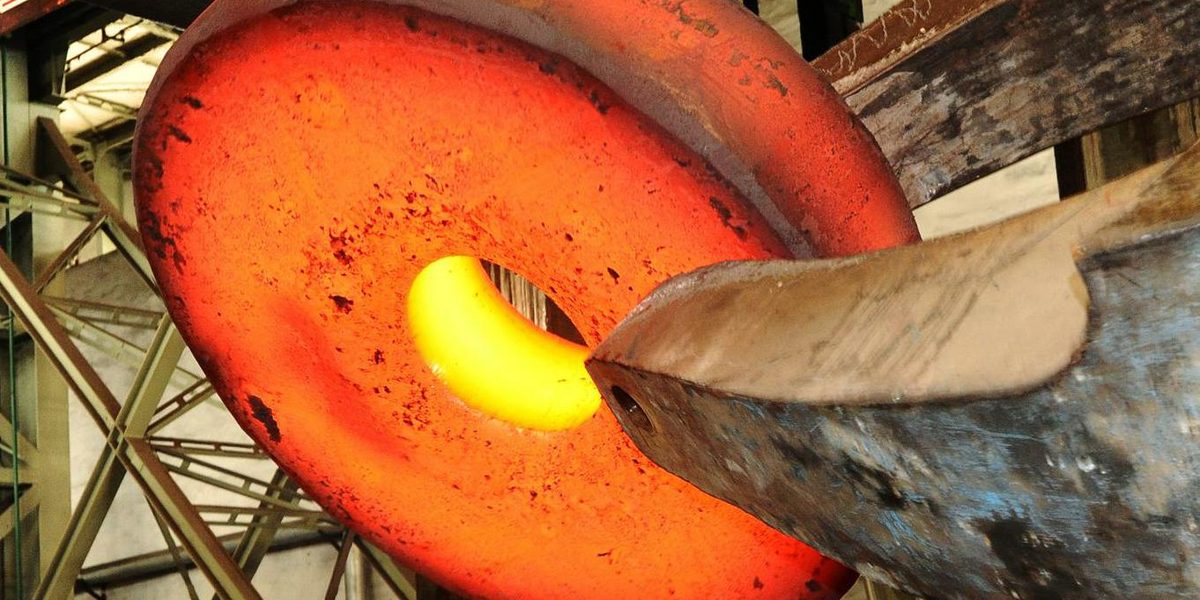
A header or manifold is the pressure boundary component that collects flow from a bundle of tubes into a single larger line, or distributes it back out again. In heat recovery steam generators, fired heaters, waste heat boilers and chemical reactor loops these parts see the harshest combination of conditions anywhere on the plant: sustained metal temperature, internal design pressure, thermal cycling at every start-up and shutdown, and a process stream that is frequently sulphidising, chlorinated or carburising. Nickel alloys are specified because carbon steel creeps away at these temperatures and 300-series stainless steel loses the fight to chloride stress corrosion cracking or sigma-phase embrittlement.
Hangbo Alloy manufactures forged and fabricated headers, manifolds and nozzle blocks in solid nickel alloy, and in clad or weld-overlaid construction where the section is heavy and the duty is corrosive rather than hot. Standard forms include straight cylindrical headers with multiple branch outlets, square and rectangular distribution boxes, forged tees and crosses, and nozzle blocks machined from solid forging. We work to ASME Section VIII Division 1 and Division 2, ASME B31.3 for the process piping interface, and to TEMA rules where the header mates to an exchanger bundle. Sizes run from small instrument manifolds of 60 mm outside diameter up to 1,200 mm OD forged shells with wall thickness beyond 60 mm.
Solid forged headers. Produced from ASTM B564 / ASME SB564 forgings in Inconel 625 (UNS N06625), Inconel 718 (N07718), Incoloy 825 (N08825), Monel 400 (N04400) and Hastelloy C276 (N10276). The forging route delivers continuous grain flow around the branch region, which is exactly what matters when the header carries a fatigue duty from repeated thermal cycles.
Fabricated manifolds from pipe. Built from ASTM B444 seamless pipe or ASTM B514 welded pipe, with extruded or integrally reinforced branch outlets. Branch reinforcement is calculated to ASME VIII UG-37 and B31.3 paragraph 304.3, and we will supply the area-replacement calculation with the quotation rather than after the order.
Nozzle blocks and bolsters. Rectangular blocks machined from plate or from a solid forging and drilled for tube attachment, normally supplied with the tube sheet and stub ends as a matched, numbered set so field fit-up is not a guesswork exercise.
Clad and overlay construction. Where the duty is corrosive but the section is heavy, an ASME SA265 clad plate or a weld overlay deposited to ASME Section IX with ERNiCrMo-3 or ERNiCrMo-4 gives an Inconel or Hastelloy wetted surface on a lower-cost backing steel. See also our dedicated clad plate range. Related forged components are covered on our forged rings page.
Grade selection follows metal temperature and process chemistry. Inconel 625 covers most sea water, flue gas and acid gas duties up to roughly 650 °C and needs no post-weld heat treatment. Inconel 718 is chosen where yield strength governs — high-pressure steam headers, wellhead manifolds and subsea distribution skids — and is supplied solution annealed and aged to API 6ACRA and NACE MR0175 / ISO 15156 hardness limits. Hastelloy C276 and C22 handle wet chlorine, oxidising acids and FGD scrubber streams; Incoloy 825 and Alloy 20 cover sulphuric and phosphoric acid service; Monel 400 remains the default for hydrofluoric acid and strongly reducing conditions. For long-term high-temperature strength we design against published creep and stress-rupture data rather than room-temperature tensile figures, a subject covered in more depth in our creep and stress-rupture guide.
Manufacture starts with a forged or rolled billet which is trepanned or bored, then ring-rolled or press-formed to shell geometry. Branch outlets are either integrally extruded from the shell wall or machined from a separate forging and attached with a full-penetration groove weld using matching-composition filler metal. Final machining of bore, sealing faces and bolt circles is done on a CNC horizontal boring mill, holding branch-to-branch pitch within ±0.5 mm. Hot-formed parts receive a full solution anneal and water quench; hardfacing of seating surfaces with Stellite or Colmonoy can be applied on request.
Every header ships with an EN 10204 3.1 or 3.2 certificate referencing the heat number, chemical analysis, mechanical test results and the heat treatment chart. Non-destructive examination typically comprises 100 % radiography or phased-array ultrasonics on all pressure-retaining welds to ASME VIII UW-51, magnetic particle or dye penetrant testing on machined surfaces to ASTM E709 or E165, and hydrostatic testing at 1.5 times design pressure with a documented hold time. Positive material identification is carried out on the finished component, not only on the raw stock.
Where the purchase order calls for it, we arrange third-party witness and inspection through BV, SGS, TUV, DNV or Lloyd's Register, and we supply the complete manufacturing record: material traceability, weld map with welder identification, NDT reports, dimensional report and, for sour service, a NACE MR0175 statement of compliance. Our quality system is certified to ISO 9001:2015 and GJB 9001C, with GOST R certification for deliveries into the Russian market. Header and manifold assemblies are supplied as pressure parts for incorporation into the client's code-stamped equipment, and we support that code package with the full material and NDT documentation set.
Solid forged headers in Inconel 625 or 718 typically ship in 6 to 9 weeks from drawing approval, with the forging billet and any third-party inspection slots on the critical path. Fabricated manifolds built from stock pipe can often be delivered in 4 to 6 weeks. Clad construction and heavy sections above 60 mm wall add two to three weeks for the additional heat treatment and NDT. Expedited slots are available for outage work.
Yes. Branch ends are supplied bevelled to ASME B16.25 or to the client's weld procedure specification, with a 1.6 mm root face and 37.5° included angle as the default. We can also leave a 3 to 5 mm machining allowance on the bore and sealing faces for final fit-up at site, and we supply stub-out weld preps matched to the specified pipe schedule.
Frequently. Send a photograph, a dimensioned sketch and the original material certificate if one survives. Where the drawing is lost we carry out a full reverse-engineering survey, including 3D scanning when the geometry is complex, and we review the failure mode before recommending a grade. In many chloride or creep failures a like-for-like replacement is not the right answer, and our engineers will say so when an alloy upgrade or a change of heat treatment is the better fix.
Send us your grade, diameter, length, quantity, and any special requirements. Our team responds within 10 minutes during business hours.