
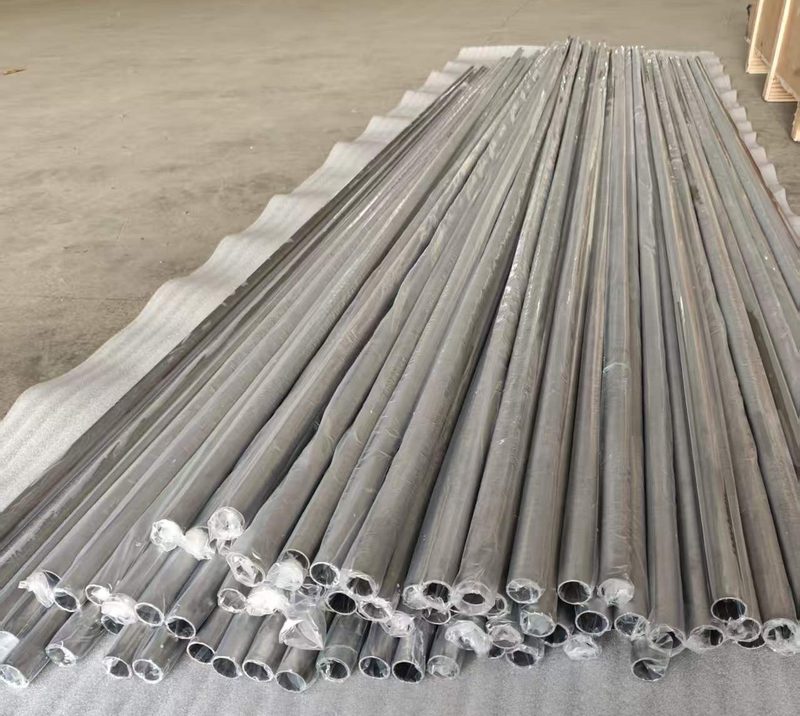
Overview
Both AISI 321 and AISI 316Ti are titanium-stabilized austenitic stainless steels designed to resist intergranular corrosion after welding or high-temperature service. While they share similar base elements (chromium, nickel, titanium), their key difference lies in molybdenum content — AISI 316Ti contains 2–3% Mo, while AISI 321 does not. This distinction fundamentally shapes their corrosion resistance profiles and optimal applications.
Chemical Composition Comparison
| Element | AISI 321 (12Cr18Ni10Ti) | AISI 316Ti (08Cr17Ni13Mo2T) |
|---|---|---|
| Carbon (C) | ≤ 0.08% | ≤ 0.08% |
| Chromium (Cr) | 17.0–19.0% | 16.0–18.0% |
| Nickel (Ni) | 9.0–12.0% | 10.0–14.0% |
| Molybdenum (Mo) | — | 2.0–3.0% |
| Titanium (Ti) | 5×C ≤ Ti ≤ 0.70% | 5×C ≤ Ti ≤ 0.70% |
| Manganese (Mn) | ≤ 2.0% | ≤ 2.0% |
| Silicon (Si) | ≤ 1.0% | ≤ 1.0% |
Corrosion Resistance — The PREN Difference
The PREN (Pitting Resistance Equivalent Number) formula = %Cr + 3.3×%Mo + 16×%N quantifies resistance to pitting corrosion:
- AISI 321: PREN ≈ 18.0 (Cr ~18%, Mo = 0)
- AISI 316Ti: PREN ≈ 25.3 (Cr ~17%, Mo ~2.5%)
A PREN > 24 is generally considered suitable for seawater service. AISI 316Ti achieves this threshold, while AISI 321 does not. In chloride-containing environments such as chemical processing plants, marine equipment, and pipelines, AISI 316Ti significantly outperforms AISI 321.
Both grades resist intergranular corrosion in the heat-affected zone (HAZ) after welding due to titanium stabilization. Ti preferentially forms TiC, preventing chromium carbide precipitation at grain boundaries.
Mechanical Properties
| Property | AISI 321 | AISI 316Ti |
|---|---|---|
| Tensile Strength (Rm) | ≥ 515 MPa | ≥ 515 MPa |
| Yield Strength (Rp0.2) | ≥ 205 MPa | ≥ 205 MPa |
| Elongation (A) | ≥ 40% | ≥ 40% |
| Density | 7.93 g/cm³ | 8.00 g/cm³ |
Temperature Performance
- AISI 321 can operate continuously to 900°C (intermittently to 950°C) in oxidizing environments. The titanium stabilization prevents harmful chromium carbide formation at these temperatures.
- AISI 316Ti is typically rated to 870°C in oxidizing conditions. Above this, molybdenum can form volatile oxides, reducing protective scale stability.
For high-temperature applications without chlorides, AISI 321 is the preferred choice. For applications requiring both temperature resistance and chloride tolerance, 316Ti provides a superior balance.
International Standards
| Standard | AISI 321 | AISI 316Ti |
|---|---|---|
| GOST (Russia) | 12Cr18Ni10Ti | 08Cr17Ni13Mo2T |
| GB (China) | 06Cr18Ni11Ti (0Cr18Ni10Ti) | 06Cr17Ni12Mo2Ti |
| DIN/EN | 1.4541 (X6CrNiTi18-10) | 1.4571 (X6CrNiMoTi17-12-2) |
| UNS | S32100 | S31635 |
Weldability
Both grades are excellent for welding without post-weld heat treatment. Titanium stabilization eliminates the need for solution annealing after welding to restore intergranular corrosion resistance. Recommended filler metals:
- AISI 321: ER321 or E321-16 electrodes
- AISI 316Ti: ER316L or E316L-16 electrodes
Cost Comparison
AISI 316Ti is typically 15–30% more expensive than AISI 321 due to the molybdenum content, which is a costly alloying element. The price difference varies with market Mo prices, product form (sheet, tube, bar), and order volume. If chloride resistance is not required, AISI 321 offers a more economical solution while retaining excellent high-temperature and general corrosion performance.
Selection Guide Summary
- Need chloride/pitting resistance? → Choose AISI 316Ti
- Need maximum temperature capability in air? → Choose AISI 321 (up to 900°C continuous)
- Marine or chemical plant environments? → Choose AISI 316Ti (higher PREN)
- Budget-sensitive, no chloride exposure? → Choose AISI 321
- Furnace components, heat exchangers in oxidizing air? → Choose AISI 321
Fabrication and Machining Comparison
Both grades are titanium-stabilised austenitics developed to survive welding and elevated temperature without sensitisation. Their shop behaviour is close, with two practical differences.
| Aspect | AISI 321 | AISI 316Ti |
|---|---|---|
| Stabiliser | Ti ≥ 5 × C | Ti ≥ 5 × C, plus 2–2.5 % Mo |
| Common filler | ER321 / ER347 | ER316Ti / ER318 |
| Machinability | Good; Ti carbides increase tool wear | Slightly harder; molybdenum raises cutting forces |
| Stabilising anneal | 870–900 °C optional | 870–900 °C optional |
| Welding | No preheat; low heat input | No preheat; low heat input |
- Titanium-stabilised grades form TiC rather than chromium carbide, so the weld heat-affected zone stays corrosion resistant.
- A stabilising anneal at 870–900 °C after welding improves resistance in strongly corrosive service.
- Use sharp carbide tooling and avoid light rubbing cuts — both grades work-harden at the surface.
Frequently Asked Questions
Which is better for welded assemblies that cannot be heat treated?
Both are designed for exactly that. Choose 321 where the duty is mainly high temperature and oxidising; choose 316Ti where chlorides or mild acids are present, since its molybdenum content roughly doubles pitting resistance.
Are 321 and 316Ti interchangeable?
Mechanically yes. Corrosion-wise no — 316Ti carries 2–2.5 % molybdenum, giving a PREN roughly 5–6 points higher, which matters in chloride-bearing and many chemical environments.
What is the upper service temperature?
Both are usable to roughly 815–870 °C in continuous oxidising service, with intermittent duty to about 900 °C. Above that, a higher-chromium or nickel-base grade is required.