
Hangbo Alloy Group
Shanghai · Est. 2012
UNS N04400 nickel-copper alloy in plate, seamless tube, bar, hex, wire and forgings — the standard choice for seawater systems, brine service and anhydrous hydrofluoric acid.
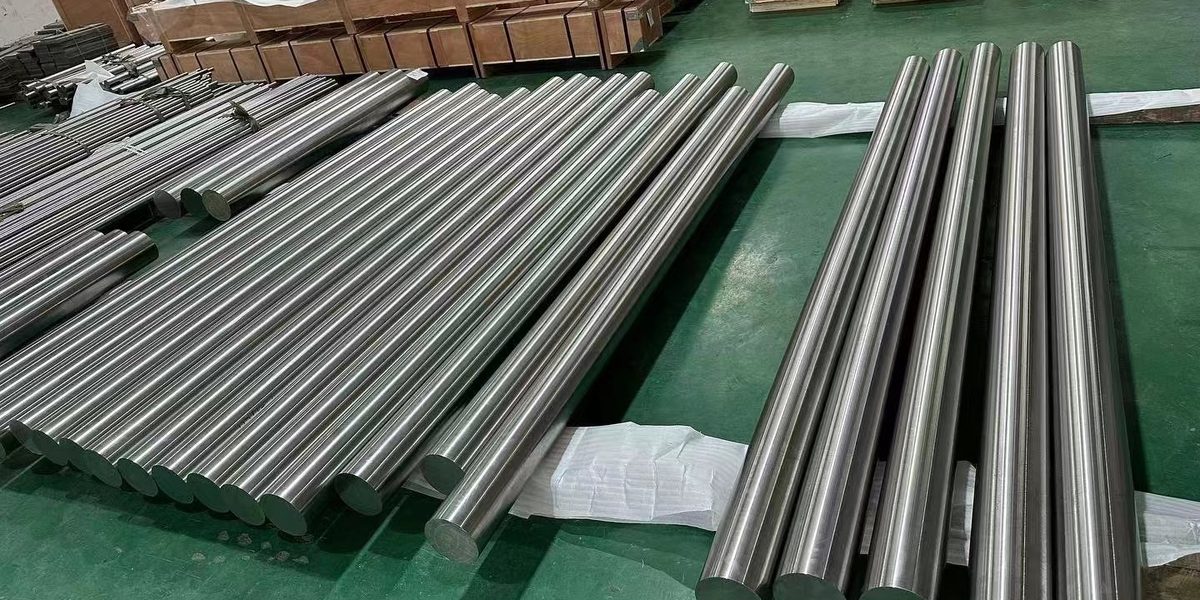
Monel 400 (UNS N04400, W.Nr. 2.4360) is a solid-solution nickel-copper alloy that has been the marine engineer's default for more than a century. Roughly two-thirds nickel and one-third copper, with controlled iron and manganese, it combines the reducing-acid resistance of nickel with the seawater behaviour of copper, and it does so at a price point well below the chromium-bearing nickel grades. Shanghai Hangbo Alloy Group supplies it as plate and sheet, seamless pipe and tube, round and hex bar, wire, forgings and butt-weld fittings.
The two duties where Monel 400 is genuinely hard to substitute are flowing seawater and hydrofluoric acid. In aerated seawater it corrodes at a small fraction of the rate of copper and copper-nickel, it resists the impingement attack that destroys condenser tubes, and it is almost immune to chloride stress corrosion cracking — the failure mode that rules out austenitic stainless steels in warm chloride service. Against anhydrous hydrogen fluoride and aqueous HF it is one of the very few metals that performs across the full concentration and temperature range, which is why alkylation units and fluorine chemical plants continue to specify it.
Buyers comparing Monel 400 with 90/10 or 70/30 copper-nickel for seawater piping, or weighing it against Monel K-500 where higher strength is needed, will find both discussions in our technical library: Monel 400 properties and applications, and Monel 400 versus copper-nickel 70/30 in seawater. Where the design needs precipitation-hardened strength rather than the annealed condition, see Monel K-500 and the free-machining variant Monel R-405.
All product forms are supplied to the governing ASTM specification with the matching ASME Section II Part B designation available on request, so the material can be used in coded pressure equipment without supplementary justification. Standard supply ranges are:
Pump and valve shafting is the single largest application for our Monel bar stock, and we routinely supply it centreless ground, straightened and polished to a specified surface finish, since shaft life in seawater is governed by the finish as much as by the alloy.
Monel 400 is melted in electric arc or induction furnaces under a controlled practice that keeps carbon at 0.30% maximum while allowing the manganese and iron needed for hot workability and for casting sound sections. Unlike the high-molybdenum grades it does not require remelting for most duties, though remelted stock is available for critical rotating parts. Nominal composition is nickel plus cobalt 63.0% minimum, copper 28.0-34.0%, iron 2.5% maximum, manganese 2.0% maximum, silicon 0.5% maximum and carbon 0.3% maximum; density is 8.80 g/cm3 and the melting range is 1300-1350 °C. Typical annealed mechanical properties are 480-620 MPa tensile, 170-345 MPa yield and 35% elongation or better.
Hot working is carried out at 650-1175 °C, with annealing at 760-980 °C depending on the section and the required grain size. The alloy is not hardenable by heat treatment — strength comes from cold work, and the common tempers are annealed, half hard and full hard for strip and wire.
Machining Monel 400 is often underestimated. It work hardens at the tool tip and produces stringy chips, so the correct approach is sharp positive-rake tooling, rigid workholding, generous depths of cut that stay below the work-hardened layer, and cutting speeds around 40 to 60% of those used for mild steel. Sulphur-bearing cutting fluids must be avoided because they attack nickel. Our machining guide for nickel alloys gives feeds and tool geometry, and the article on erosion-corrosion explains why surface finish matters so much in high-velocity seawater.
Welding uses AWS A5.14 ERNiCu-7 filler for GTAW, GMAW and SAW, or AWS A5.11 ENiCu-7 covered electrodes. Full details of joint design, interpass control and common defects are given in our nickel alloy welding guide.
Material is produced and released under our ISO 9001:2015, GJB 9001C and GOST R certified quality systems. Each piece carries its heat identification through to delivery so that the certificate can be tied back to a specific length of tube or a specific bar; our article on heat number traceability after delivery explains how that identification is preserved once material is cut into spools.
Every shipment is released with an EN 10204 3.1 certificate giving cast analysis, mechanical test results, heat treatment record, dimensional check and NDT results. EN 10204 3.2 with independent counter-signature is available. Positive material identification separates Monel 400 from Monel R-405 and from cupronickel before despatch — see PMI for nickel alloys and verifying a mill test certificate.
Tube is hydrostatically or eddy current tested to ASTM B165; bar and plate can be ultrasonically examined to the applicable product specification; forgings receive dye penetrant and, where specified, volumetric examination. For sour service orders we confirm hardness and condition against NACE MR0175 / ISO 15156 before release. Independent inspection by BV, SGS, TUV, DNV or Lloyd's Register can be written into the order, with hold points agreed in the inspection and test plan as described in third-party inspection hold points.
Copper-nickel 90/10 is cheaper and adequate for clean, moderate-velocity seawater. Monel 400 earns its premium where velocity or turbulence is high, where the water carries entrained sand or solids, where the line sits in the splash zone, or where the process stream contains hydrofluoric acid, hot caustic or reducing acids. It also removes the chloride stress corrosion cracking risk that limits stainless steels in warm seawater.
Monel 400 is essentially non-magnetic in the annealed condition, which is one reason it is used for instrumentation and for equipment near compasses and degaussing systems. It remains tough at sub-zero temperatures because it is a face-centred cubic solid solution with no ductile-to-brittle transition, and it is used for LNG and cryogenic transfer components where austenitic stainless would risk sensitisation during welding.
Common sizes of bar and seamless tube in ASTM B165 and B164 are normally held in stock and can ship within one to two weeks. Non-standard diameters, heavy wall tube and large forgings are made to order, typically four to eight weeks depending on melt slot and finishing. Send your sizes, quantity and required certification level and we will quote firm ex-works and delivered lead times.
Send us your grade, diameter, length, quantity, and any special requirements. Our team responds within 10 minutes during business hours.