
Hangbo Alloy Group
Shanghai · Est. 2012
Monel 400 and Monel 404 are both nickel-copper solid-solution alloys built on the same ~67% nickel, ~30% copper base, so at a glance they look interchangeable. They are not. The difference is a tight set of impurity limits — iron, manganese, silicon, carbon — that make 404 the grade chosen when brazing, glass-to-metal sealing or low magnetic permeability decide the part. This comparison explains where each belongs and how to avoid paying for 404 when 400 will do, or accepting 400 where only 404 qualifies.
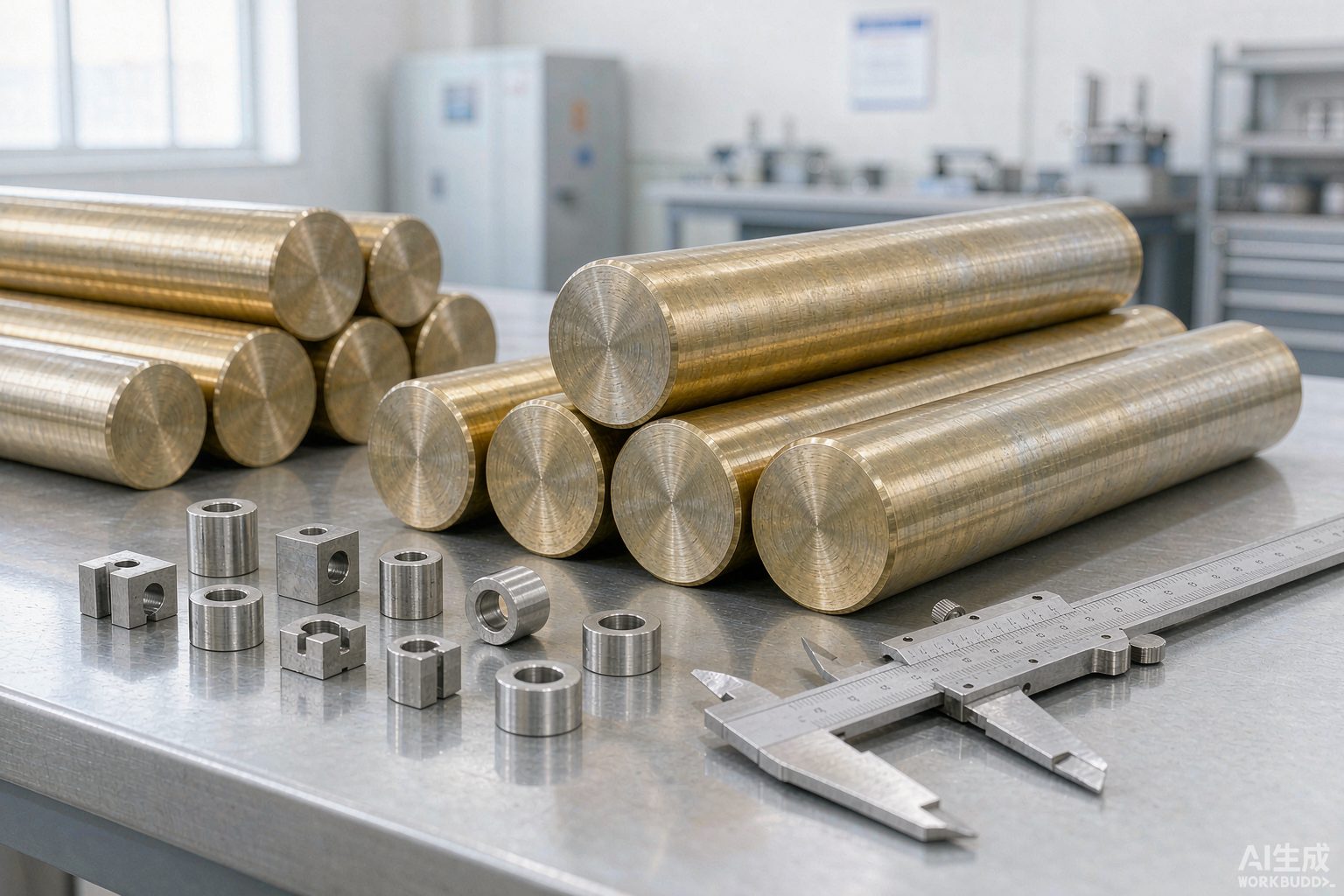
Monel 400 and Monel 404 sit on the same nickel-copper foundation, so buyers often assume they are interchangeable and quote them as if the numbers meant the same thing. They are related, not identical. Both are solid-solution Ni-Cu alloys with roughly two-thirds nickel and one-third copper, but 404 is defined by a tight band of impurity limits — iron, manganese, silicon and carbon held far below 400 levels — that exist for one reason: brazing, glass-to-metal sealing and low magnetic sensitivity in electronic parts. The buying decision is therefore not “which is better” but “which impurity limits my part actually requires.”
We supply both from our Shanghai lines and we document the controlling chemistry on every certificate, because the 400-versus-404 question is where silent substitution does the most damage: a trader can ship 400 against a 404 drawing and the base properties look fine on paper while the part fails in the braze. Our procurement pitfalls guide covers how substitution shows up across the supply chain, and this comparison focuses on the one difference that decides the grade.
For the seawater angle, our Monel 400 versus copper-nickel guide explains why 400 is not always the right nickel-copper choice when chloride service is involved.
Both grades are nickel-copper solid solutions: nickel is the majority element, copper is the deliberate second addition, and everything else is a controlled trace. That shared matrix is why their corrosion resistance in many environments, their strength band, and their weldability all overlap. In a pump shaft or a seawater fastener, 400 and 404 would behave almost the same, because the property that matters there is the Ni-Cu base, not the trace impurities.
The practical consequence is that 404 is never chosen for higher strength or better corrosion resistance — it is chosen when the assembly process or the function is sensitive to the impurities 400 carries freely. If your drawing names 404, it is almost always because of a braze, a seal or a permeability requirement, not because 400 would corrode or break. Reading the specification for the controlling limit, not the headline grade, is what prevents both over-buying and under-specifying.
The single sentence answer: Monel 404 holds iron, manganese, silicon and carbon to a fraction of the Monel 400 limits, and those four elements are what compromise brazing, glass-to-metal sealing and magnetic stability. Iron and manganese oxidise and can outgas during a braze cycle; silicon forms low-melting phases that weaken a joint; carbon and the magnetic response matter where a part must stay non-magnetic or expand predictably against glass. Dropping these to near-zero is what makes 404 a qualified electronic grade rather than just “400 with a stricter certificate.”
This is also why 404 costs more and is supplied in thinner, cleaner forms: the melt must be kept tight, the processing must avoid pickup, and the certificate must report the actual values, not just the base. A buyer who treats 404 as a cosmetic upgrade over 400 misunderstands it; a buyer who treats 400 as a cheap substitute for 404 on a sealed part courts a joint failure.
The table below lists typical limits for the two grades. Values are representative of ASTM B164 / B127 product specs; always confirm the current edition and your own drawing limits before acceptance. The columns that separate the grades are iron, manganese, silicon and carbon — everything else moves together because the base is the same.
| Element (wt%) | Monel 400 (N04400) | Monel 404 (N04404) | What the difference controls |
|---|---|---|---|
| Nickel | 63.0 min (bal.) | 63.0–70.0 (bal.) | Base, same family |
| Copper | 28.0–34.0 | 28.0–34.0 | Base, same family |
| Iron | ≤2.50 | ≤0.05 | Braze cleanliness, permeability |
| Manganese | ≤2.00 | ≤0.05 | Outgassing in seals |
| Silicon | ≤0.50 | ≤0.10 | Joint integrity |
| Carbon | ≤0.30 | ≤0.15 | Grain and magnetic stability |
| Sulfur | ≤0.024 | ≤0.015 | Cleanliness |
| Aluminium | ≤0.50 | ≤0.05 | Controlled for sealing |
The iron and manganese rows are the quick tell. If a certificate stamped “404” shows iron or manganese anywhere near 400 levels, the grade is wrong regardless of the UNS printed on the header. Our MTC verification guide walks through catching exactly this kind of mismatch.
Because the matrix is the same, the mechanical and corrosion properties overlap enough that neither grade is picked for a property edge. Both offer good resistance to seawater, steam and many non-oxidising acids, good strength from the solid-solution matrix, and the work-hardening behaviour typical of Ni-Cu alloys. The numbers below are representative of the annealed condition and illustrate the overlap, not a performance gap.
| Property (annealed, typical) | Monel 400 | Monel 404 | Note |
|---|---|---|---|
| Tensile strength | ~550 MPa | ~520 MPa | Overlap, condition-dependent |
| Yield strength | ~240 MPa | ~230 MPa | Overlap |
| Elongation | ~40% | ~40% | Similar ductility |
| Density | ~8.80 g/cm³ | ~8.80 g/cm³ | Essentially identical |
| Magnetic permeability | Low, but higher with Fe/Mn | Very low (tight Fe/Mn) | Where 404 is specified |
| Seawater resistance | Excellent | Excellent | Base-driven, same |
The only row that separates them in function is magnetic permeability, and that separation exists only because 404 holds iron and manganese down. If permeability is not in your specification, that row is irrelevant and 400 is the economical choice.
Monel 400 is the general grade: valve parts, pump shafts, fasteners, seawater fixtures, heat-exchanger tubing and marine hardware where the Ni-Cu base does the work. Monel 404 is the specialist: electronic component leads, glass-to-metal seal rings, brazed assemblies, and any part where outgassing or a permeability shift would spoil the function. The application split is the cleanest way to decide.
| Use | Preferred grade | Why |
|---|---|---|
| Seawater pump shaft, fasteners | 400 | Base corrosion resistance, cost |
| Marine valve trim | 400 | Strength and corrosion, no seal need |
| Glass-to-metal seal ring | 404 | Low Fe/Mn, stable expansion |
| Brazed electronic lead frame | 404 | Clean braze, low outgassing |
| Non-magnetic sensor housing | 404 | Very low permeability |
| Chemical plant tray | 400 | General corrosion, economy |
If your part is brazed, sealed or magnetic-sensitive, 404 is the safe specification; if it is a structural or seawater part with no such requirement, 400 is usually correct and cheaper. Our mill-versus-trader guide matters here because 404's tight chemistry is easier to guarantee from a controlled melt than from an unknown source.
The rule is simple but easy to violate under price pressure: 400 may replace 404 only when your drawing imposes no controlling impurity limit and you document the acceptance in writing; 404 must never be “up-sold” as a free upgrade on a 400 job where the cost is unwarranted, and 400 must never be slipped into a 404 order. Either direction of silent swap is a specification breach. The certificate is the only defence — read the UNS and the actual Fe/Mn/Si/C values, not just the trade name.
A related trap is the cheap quote. A supplier offering 404 at 400 prices, or 400 against a 404 drawing, is often moving the chemistry, and our cheap-quote guide explains why a price that looks too good usually means something material changed. For an impurity-critical grade, melt source is the second control: a virgin charge keeps tramp elements out far more reliably than remelt.
Put these requirements on every Monel inquiry and the 400/404 confusion closes before it reaches the dock:
Use these references when specifying Monel 400 or 404. Always confirm the current edition of any standard you cite.
| Topic | Reference | What it gives you |
|---|---|---|
| Rod, bar, wire, forging | ASTM B164 | Composition and mechanical limits for 400 and 404 |
| Plate, sheet, strip | ASTM B127 | Form-specific chemistry and tolerances |
| UNS nomenclature | SAE AMS / UNS N04400, N04404 | Unambiguous grade identity |
| Brazing filler practice | AWS / AMS brazing specs | Basis to require low-outgassing chemistry |
| Certification | EN 10204 3.1 / 3.2 | Route to have chemistry signed and traceable |
Our MTC verification guide explains how to turn these references into a receiving check that catches a 400-cert stamped as 404.
They share the same nickel-copper solid-solution base, so their corrosion behaviour and strength are broadly similar, but they are not the same grade. 404 holds iron, manganese, silicon and carbon to much lower limits than 400, and those limits are what make 404 suitable for brazing and electronic parts. Treat them as related grades with different qualification, not as substitutes by default.
Because those elements affect brazing and glass-to-metal sealing. Iron and manganese can oxidise or outgas during braze cycles and can shift the thermal expansion and permeability that electronic and sealed parts depend on. Holding them very low keeps the braze clean and the magnetic and expansion behaviour stable, which is exactly why 404 exists as a separate specification.
Only if your drawing does not actually require the 404 impurity limits, and you can document that in writing. If the part is brazed, glass-sealed or magnetic-sensitive, substituting 400 risks leaks, outgassing or a permeability shift that the design will not tolerate. Never accept the swap silently; require the supplier to confirm the UNS and the controlling impurity values against your specification.
Not in any way that matters for selection. The mechanical and corrosion profiles of the two grades overlap because the base is the same; 404 is chosen for its controlled impurities, not for higher strength or better corrosion resistance. If those properties alone drove the choice, 400 would usually be the economical answer.
Read the melt certificate for the UNS number and the actual iron, manganese, silicon and carbon values, then confirm they sit inside the limit your specification names. For 404 the iron and manganese lines are the tell-tale; if they read like 400 levels, the grade is wrong. Our MTC verification guide covers how to catch a certificate that reports the base but not the controlling impurities.
It can, because tramp elements are harder to keep out of a low-impurity grade. A controlled virgin charge and clean melting give a more predictable iron, manganese and silicon than remelted scrap, which is why the impurity-critical 404 is a grade where melt source and traceability deserve extra scrutiny. Our virgin-versus-scrap guide explains the mechanism.
Yes, the working behaviour is similar because the matrix is the same nickel-copper solid solution, so welding, forming and machining practice carry across. The caution is only that 404 parts are usually thin, sealed or electronic, so fit-up and cleanliness during joining matter more than they would on a heavy 400 structural part.
If your drawing names Monel but does not state the UNS or the impurity limits, or a quote offers 404 at a 400 price, send it to us with the grade, form, the application and any brazing or sealing requirement. We will confirm whether 400 meets it or only 404 qualifies, and quote our own production with the controlled chemistry and full heat-to-piece traceability. Typical response time is ten minutes, and we ship worldwide from Shanghai.
Email: serena@hangboalloy.com
Phone: +86 166 2109 2936
WhatsApp: +86 166 2109 2936
Send us your grade, product form, the application (especially any brazing, sealing or electronic requirement) and the impurity limits on your drawing. We will confirm whether 400 meets it or whether only 404 qualifies, and quote our own production with the controlled chemistry and full traceability.