
Hangbo Alloy Group
Shanghai · Est. 2012
Two pieces of Inconel can pass the same chemistry yet behave differently in service because one was double melted. This guide explains what VIM, ESR and VAR each remove, how VIM+ESR compares with VIM+VAR, and how to confirm the route on your certificate.
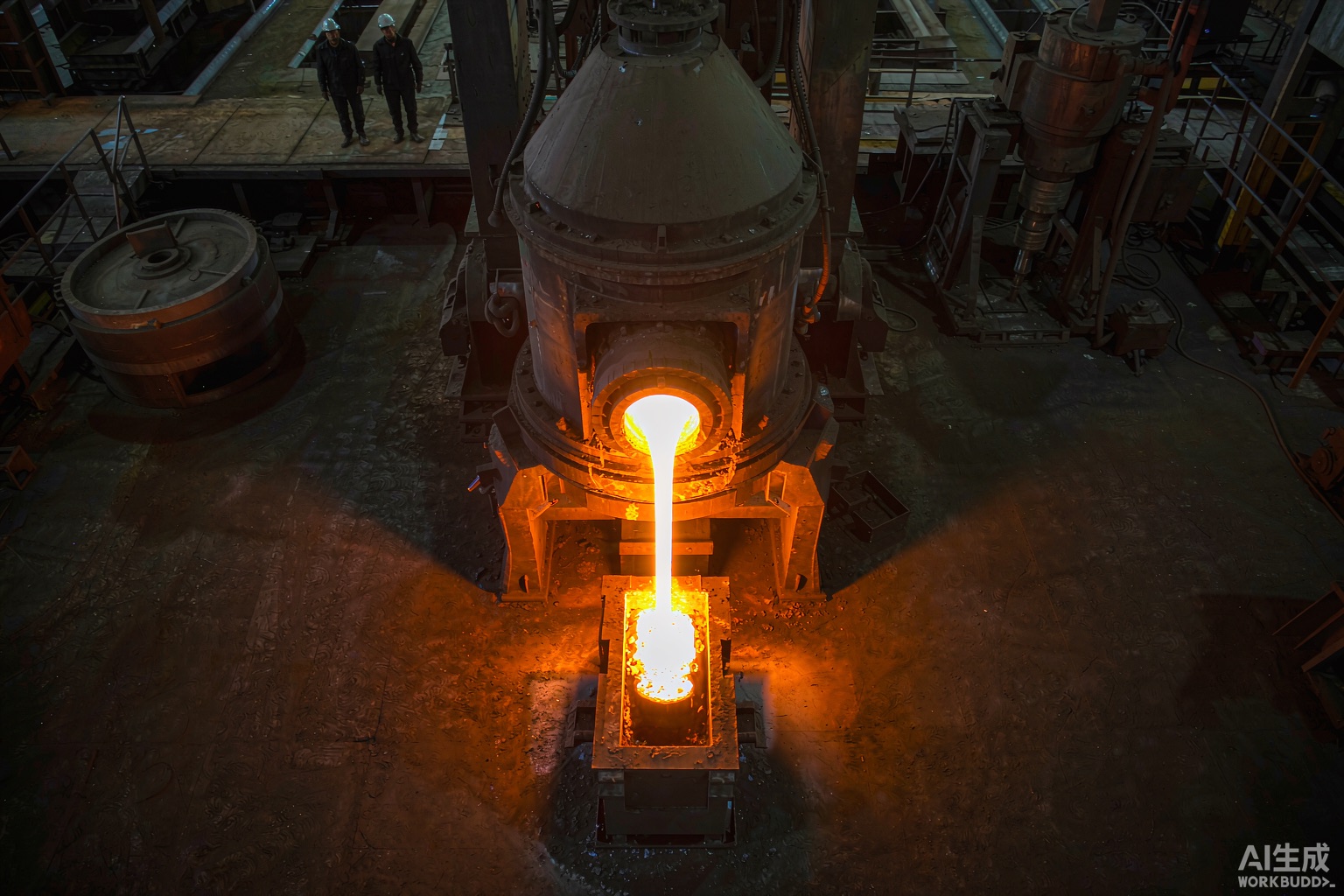
Two pieces of Inconel 625 can meet identical composition and property limits and still behave completely differently in service, because one was double melted and the other was not. The melting route — how the heat was refined after the first melt — decides the gas content, the inclusion count, the tramp-element level and the soundness of the ingot. For rotating parts, welded structures and sour service, that route is the variable that quietly separates a twenty-year life from a premature failure.
This guide explains what VIM, ESR and VAR each do, why VIM+ESR and VIM+VAR are the two standard double-melt routes for nickel alloy, and how to confirm the route you paid for actually produced your heat. The point is practical: the melting route is a line on the certificate you can require, not a mystery locked inside the melt shop.
We operate both routes at Shanghai Hangbo Alloy Group Co., Ltd. Our vacuum induction furnaces feed electroslag or vacuum arc remelting, and we select VIM+ESR or VIM+VAR per alloy and end use rather than by habit. Our seamless pipe guide shows the route feeding a finished product, and our procurement pitfalls guide explains why the route is the least-understood buying variable. Confirming the route also means confirming the melt shop that ran it — our origin and melt-shop verification guide shows how to require the furnace identity and country of melt on the certificate.
Composition tells you what elements are present; the melting route tells you how cleanly and how homogeneously they are distributed. A single air or induction melt can meet the chemistry but leave dissolved gases, sulphide and oxide inclusions, volatile tramp elements and centre porosity that no later step removes. Secondary remelting is the stage that cleans the metal up.
The failure signatures are well known: inclusions and gas porosity cause low-cycle fatigue and leak paths; macrosegregation causes uneven properties along a forging; tramp elements such as lead and bismuth cause hot shortness and liquation cracking during welding and hot working. None of these show on a composition certificate, which is exactly why the route must be stated separately.
| Defect family | Caused by | Removed by |
|---|---|---|
| Dissolved gases (O, N, H) | Air contact, no degassing | VIM vacuum, further by VAR |
| Oxide / sulphide inclusions | Crucible, slag, revert | ESR slag reaction; clean VIM |
| Volatile tramp (Pb, Bi, Sn, Sb) | Uncontrolled scrap | VAR evaporation under vacuum |
| Macrosegregation, centre unsoundness | Uncontrolled solidification | Directional ESR/VAR solidification |
Three processes, three jobs. VIM melts and degasses; ESR cleans through a reactive slag; VAR cleans under vacuum.
| Process | What happens | What it controls best |
|---|---|---|
| VIM (vacuum induction melting) | Charge melted in an induction coil under vacuum | Tight chemistry, dissolved-gas removal, alloying control |
| ESR (electroslag remelting) | VIM electrode remelted through a conductive slag | Sulphur and oxide inclusions, directional solidification |
| VAR (vacuum arc remelting) | VIM electrode remelted by arc under vacuum | Gas and volatile tramp elements, cleanliness |
VIM sets the chemistry and pulls the first gas load out under vacuum. ESR then drips the electrode through a molten slag that reacts with and absorbs inclusions and sulphur, while the ingot freezes directionally from the bottom, keeping chemistry uniform from surface to core. VAR remelts under hard vacuum, driving off hydrogen, nitrogen and the volatile tramp elements by evaporation, with a molten pool whose shape must be actively controlled.
Both start with VIM. The choice of second step is the engineering trade. ESR leans on slag refining; VAR leans on vacuum refining.
| Attribute | VIM + ESR | VIM + VAR |
|---|---|---|
| Dissolved gases (O, N, H) | Low, set during VIM | Lowest, reduced further under vacuum arc |
| Sulphide / oxide inclusions | Very low — slag absorbs them | Low |
| Volatile tramp (Pb, Bi, Sn, Sb) | Partly reduced | Lowest — evaporated under vacuum |
| Macrosegregation | Good — controlled directional freezing | Good with careful pool control |
| Typical defects if uncontrolled | Tree-ring (banding) segregation | White spots, freckles |
| Typical use | Bar, plate, tube, forgings for corrosion and high temperature | Rotating and high-cycle-fatigue-critical parts |
In plain terms: VIM+ESR gives you excellent cleanliness through slag refining and a homogeneous ingot, ideal for corrosion and high-temperature product forms. VIM+VAR drives gas and tramp elements to their lowest levels, ideal where fatigue and rotating load dominate. For the most demanding turbine discs a triple melt (VIM+ESR+VAR) is used.
The table below maps each contaminant to the route that most efficiently removes it, so you can match the route to the risk in your service.
| Contaminant | Best removed by | Why it matters in service |
|---|---|---|
| Hydrogen | VIM, then VAR | Hydrogen embrittlement, delayed cracking |
| Oxygen / nitrogen | VIM vacuum, VAR | Nitride/oxide inclusions, notch sensitivity |
| Sulphur | ESR slag desulphurization | Sulphide inclusions, hot ductility |
| Lead, bismuth, tin, antimony | VAR evaporation | Hot shortness, weld liquation cracking |
| Oxide inclusions | ESR and clean VIM | Fatigue initiation, leak paths |
| Centre porosity / banding | Directional ESR/VAR freezing | Uneven properties, forging defects |
This is why a virgin charge matters too: secondary remelting cleans, but it cannot un-mix tramp elements already present in scrap. Our welding guide covers how tramp elements surface as cracks during fabrication.
Each remelt process has a signature defect if its pool is mismanaged, and double melting is precisely what suppresses them. White spots in VAR are hard, non-metallic inclusions from the skull that act as fatigue initiators. Freckles are local solute-rich rosettes from pool instability. Tree-ring (banding) in ESR is a cyclical segregation pattern from unstable freezing. A well-run double-melt route does not let these form.
For age-hardened alloys the route matters doubly, because precipitates such as gamma prime nucleate on inclusions and segregate with chemistry. Our precipitation-strengthening guide explains why a clean, homogeneous starting ingot gives more predictable ageing.
The commercial takeaway is that the route is cheap insurance against the most expensive failures. A white spot that becomes a fatigue origin, or a freckle that becomes a local soft spot, is invisible on a composition certificate and only shows up as a field failure years later. Specifying and confirming the route moves that risk back to the melt shop, where it can actually be controlled.
The route is documented, not mystical. Require it on paper and the melt shop can prove it.
| Evidence | What to require | What a real mill can show |
|---|---|---|
| Certificate field | Melting route, furnace identity, heat number | VIM+ESR or VIM+VAR stated explicitly |
| Melt log | Furnace serial and cycle record | Furnace carries a serial number |
| Photograph / video | Heat in progress on request | Possible because the furnace is identifiable |
| Independent analysis | Gas and tramp-element check | Confirms the cleanliness the route claims |
Be sceptical when the answer is "confidential", or when a trading company cannot name the melt shop. A mill that owns ESR or VAR equipment has nothing to hide about a heat in progress.
Beyond VIM+ESR and VIM+VAR, the most demanding alloys use a triple melt — VIM followed by ESR followed by VAR — to combine slag cleaning with the lowest possible gas and tramp levels. This is the route for premium turbine discs and blades, where a single inclusion is a flight-safety event. Some programmes also use electroslag remelting with a consumable mould or additional vacuum degassing, but the principle is constant: each remelt step cleans one more thing.
| Route | What it adds | Use |
|---|---|---|
| VIM only | Chemistry control and degassing | Non-critical forms |
| VIM + ESR | Slag cleaning, homogeneous ingot | Corrosion and high-temperature forms |
| VIM + VAR | Lowest gas and tramp levels | Rotating and fatigue-critical parts |
| VIM + ESR + VAR | Both, cleanest ingot | Aerospace discs and blades |
The route is a ladder of increasing cleanliness and cost; you climb it only as far as the service demands. Our Inconel 718 aerospace guide covers a grade where the top of that ladder is normal practice.
Double melting costs more furnace time and energy, so a buyer should know what the money buys. The benefit is not a higher number on the certificate; it is lower scatter in properties, fewer inclusion-initiated failures, and predictable weldability — all of which reduce lifecycle cost far more than the melting premium costs up front.
| Spend | Return |
|---|---|
| Second remelt furnace time | Fewer rejects, longer service life |
| Vacuum degassing (VAR) | Lower tramp elements, cleaner welds |
| Slag refining (ESR) | Fewer inclusions, uniform properties |
| Route documentation | Traceable, auditable quality |
For a non-critical bracket the premium may not pay back; for a sour-gas valve or a turbine shaft it is cheap insurance. The discipline is to specify the route to the risk, not to a blanket rule.
As a practical rule, corrosion and high-temperature product forms — bar, plate, tube and forgings in Inconel, Hastelloy, Incoloy and Monel — are usually specified VIM+ESR, while rotating and age-hardened parts lean toward VIM+VAR. The exact requirement sits in the applicable ASTM B-product specification or the AMS for the grade, and naming it on the order is what makes it enforceable.
Our Inconel 625 guide and Hastelloy C-276 guide show grades where double melting is the norm, and our seamless pipe guide shows the route feeding a finished tube.
Two myths cost buyers money. The first is that "vacuum melted" means double melted — it does not; a single VIM is vacuum melted and still untempered by remelt, so the term alone proves nothing. The second is that cleaner always means better for every part; for a static, non-welded, low-stress component a single clean melt may be perfectly adequate, and paying for triple melt is wasted margin. Match the route to the failure mode, not to the brochure.
If you want to be sure the route is real, ask direct questions before you order and judge the answers. A mill that owns the equipment answers without hesitation; a trading company cannot, because it never saw the heat.
| Ask | A good answer |
|---|---|
| Which route did this heat use? | VIM+ESR or VIM+VAR, named explicitly |
| Can you show the furnace? | Yes — serial number and melt log |
| Is the charge virgin? | Yes, with incoming lot analysis |
| What is your inclusion rating? | An ASTM E45 result on request |
| Will the route be on the certificate? | Yes, as a stated field |
These five questions compress the whole route-control story into a pre-order conversation. If any answer is "confidential" or deflects to a trading layer, that is the answer — and you should look elsewhere.
| Need | Reference / practice | Note |
|---|---|---|
| Double-melt requirement | Many ASTM B-product specs call for VIM+ESR or VIM+VAR for critical grades | Name the route on the PO |
| Inclusion rating | ASTM E45 (or applicable) inclusion assessment | Evidence of cleaning |
| Gas analysis | Combustion / inert-gas fusion for O, N, H | Confirms degassing |
| Tramp elements | ICP-OES / glow-discharge for Pb, Bi, Sn, Sb | Confirms VAR-level control |
| Rotating parts | Inconel 718 aerospace guide | VAR preferred for discs and shafts |
This article is metallurgical guidance, not a legal opinion or a substitute for the applicable standard. Always verify against the current edition of the specification you order to.
Trademark note: Inconel, Hastelloy, Incoloy, Monel, Nimonic and Haynes are trademarks of their respective owners; the grades covered here are defined by their UNS numbers and the applicable ASTM or EN standards, not by the brand names.
Both begin with vacuum induction melting. ESR then remelts the electrode through a reactive slag that absorbs inclusions and sulphur and freezes the ingot directionally; VAR remelts it under hard vacuum, driving off gases and volatile tramp elements. ESR leans on slag refining for corrosion and high-temperature forms; VAR leans on vacuum refining for rotating and fatigue-critical parts.
Because chemistry does not capture gas content, inclusions, tramp elements or macrosegregation. A single melt can meet the composition yet carry porosity, sulphides and lead that cause fatigue, hot cracking and uneven properties. Only the remelt route removes those, and only stating it on the certificate makes it verifiable.
For turbine discs, shafts and other high-cycle-fatigue components, VIM+VAR (or VIM+ESR+VAR triple melt for the most demanding discs) is the usual choice because vacuum arc remelting drives gas and volatile tramp elements to their lowest levels. For static corrosion and high-temperature forms, VIM+ESR is typically sufficient.
No. Once lead, bismuth, tin or antimony are in the liquid metal they are essentially impossible to remove except by evaporation under vacuum during VAR, or by not being there in the first place through a virgin charge. That is why the charge material and the route are both part of quality.
Require the melting route, furnace identity and heat number on the certificate, and ask the mill to name the melt shop and show a melt log or photograph of the heat. A genuine mill with ESR or VAR equipment can do this; a trading company that calls the detail confidential cannot.
For non-critical, low-consequence forms a single vacuum or air melt may be acceptable, but for corrosion, high-temperature, welded, sour or rotating service the double-melt route is the norm in the ASTM B-product specifications. Specify it so the certificate must confirm it.
Both are far better than a single melt for welded construction, because both lower inclusions and tramp elements that cause liquation cracking. VAR's lower tramp-element levels give the cleanest weldability margin, but VIM+ESR is widely used and accepted where corrosion service dominates.
If you need to specify the right melting route for a nickel-alloy part, or you want to confirm the route on material you were offered, send us the grade, product form, dimensions, quantity and service environment. We will recommend VIM+ESR or VIM+VAR for your use, quote our own virgin-material, double-melted production with the route stated on the certificate, and supply the furnace identity and heat number for full traceability. Typical response time is ten minutes, and we ship worldwide from Shanghai.
Email: serena@hangboalloy.com
Phone: +86 166 2109 2936
WhatsApp: +86 166 2109 2936
Send us the grade, product form, dimensions, quantity and service environment. We will recommend VIM+ESR or VIM+VAR for your use, quote our own virgin-material, double-melted production with the route stated on the certificate, and supply the furnace identity and heat number for full traceability.