
Hangbo Alloy Group
Shanghai · Est. 2012
UNS N08825 in plate, seamless tube, bar, forgings and fittings — titanium-stabilised for sulphuric and phosphoric acid, FGD scrubbers and sour gas service.
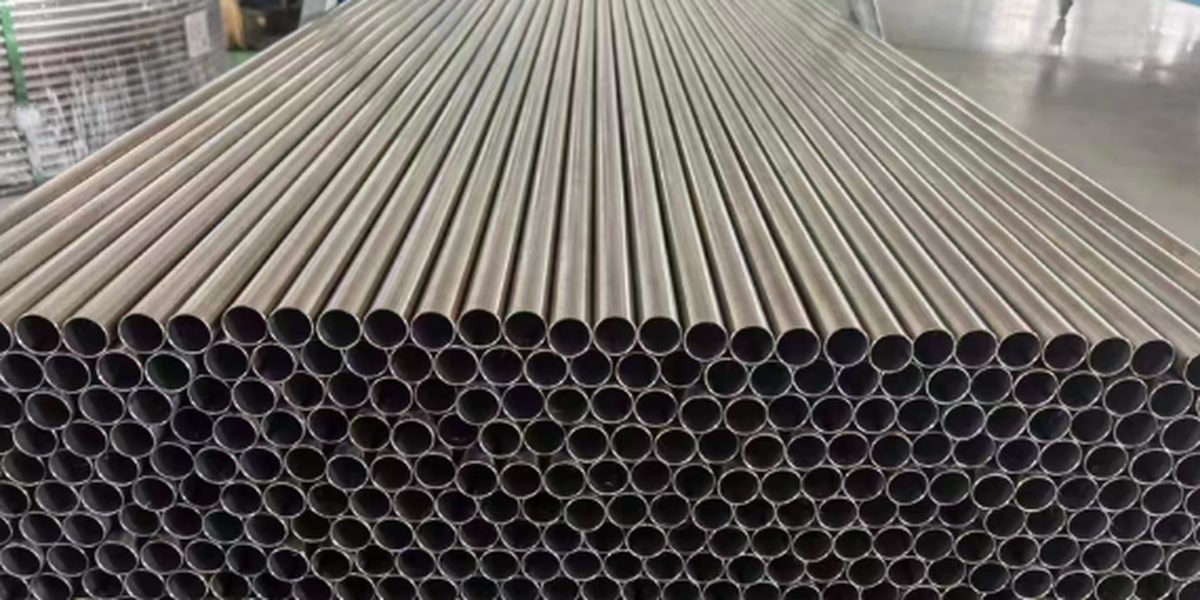
Incoloy 825 (UNS N08825, W.Nr. 2.4858, DIN NiCr21Mo) is a titanium-stabilised nickel-iron-chromium alloy with additions of molybdenum and copper. It was developed to give stainless-steel-like economy of alloy content while still handling the two duties that destroy 316L: hot sulphuric and phosphoric acid, and sour hydrocarbon streams containing hydrogen sulphide and chlorides. Shanghai Hangbo Alloy Group supplies it in plate and sheet, seamless pipe and tube, round bar, forgings, tube sheets and butt-weld fittings.
The stabilisation is the key design feature. Titanium at 0.6-1.2% ties up carbon as titanium carbide so that chromium carbides do not precipitate at grain boundaries during welding or service. The practical result is that welded 825 equipment resists intergranular attack in the as-welded condition, which matters for the large field-fabricated tanks, ducting and scrubber shells the alloy is typically used for. Chromium at 19.5-23.5% handles oxidising acids and oxidising contaminants, molybdenum at 2.5-3.5% plus copper at 1.5-3.0% handle reducing acids, and the roughly 40% nickel content provides immunity to chloride stress corrosion cracking.
Typical applications are sulphuric acid pickling tanks and piping, phosphoric acid evaporators, flue gas desulphurisation absorber towers and outlet ducting, nuclear fuel reprocessing dissolvers, seawater-cooled heat exchangers, acid gas gathering lines, downhole tubing and wellhead components in sour fields, and waste-to-energy boiler protection. Guidance on the corrosion side is in our articles on Incoloy 825 high-temperature performance, sulphuric acid alloy selection and Inconel 625 versus Incoloy 825.
Material is delivered to the governing ASTM specification, with the corresponding ASME Section II Part B designation available where the equipment is code-stamped. Our regular supply envelope covers:
Because 825 is often used in very large fabrications, we pay particular attention to plate flatness, edge preparation and to supplying matched heat lots so that a single vessel or scrubber tower is built from material with consistent chemistry and consistent welding response.
Nominal composition is nickel 38.0-46.0%, chromium 19.5-23.5%, iron 22.0% minimum as balance, molybdenum 2.5-3.5%, copper 1.5-3.0%, titanium 0.6-1.2%, with carbon limited to 0.05%, manganese to 1.0%, silicon to 0.5%, aluminium to 0.2% and sulphur to 0.03%. Density is 8.14 g/cm3 and the melting range is 1370-1400 °C. Annealed room-temperature properties are typically 590 MPa tensile, 220 MPa yield and 30% elongation, with the alloy retaining useful strength to around 550 °C and oxidation resistance to about 1000 °C in clean atmospheres.
Solution annealing is performed at 940-980 °C followed by rapid cooling; a stabilising treatment at around 900 °C may be applied where the service is particularly aggressive. Stabilising anneals are also used on weldments of thick section. Hot forming is done at 900-1180 °C and should not be continued below about 900 °C. Cold forming is straightforward, with intermediate annealing needed for heavy reductions.
Welding uses AWS A5.14 ERNiCrMo-3 (Inconel 625 type) or ERNiFeCr-1 (825 type) filler for GTAW, GMAW and SAW, and AWS A5.11 ENiCrMo-3 or ENiFeCr-1 covered electrodes. Matching-composition 825 filler is chosen where the weld metal must corrode at the same rate as the parent metal; overmatching with 625 filler is common where higher weld strength and pitting resistance are wanted. Interpass temperature is normally held below 150 °C. Properly executed welds do not need post-weld heat treatment. Our nickel alloy welding guide covers the procedure detail, and where the duty is sour the limits in NACE MR0175 should be confirmed before the grade is fixed.
All Incoloy 825 is produced and released under our ISO 9001:2015, GJB 9001C and GOST R certified quality systems, with full heat traceability from melt through to the delivered piece; our note on heat number traceability explains how identification is maintained through cutting and spooling.
Each shipment carries an EN 10204 3.1 mill test certificate reporting cast analysis, mechanical properties, heat treatment record, dimensions and test results. EN 10204 3.2 with independent counter-signature is available for project work. Positive material identification is carried out on 100% of pressure-retaining product where specified, using XRF with OES confirmation for titanium and molybdenum; see PMI for nickel alloys and verifying a mill test certificate.
Tube is hydrostatically or eddy current tested to ASTM B423. Plate and bar can be ultrasonically examined to the applicable product standard or to ASTM A578 Supplementary Requirement level on request. Intergranular corrosion testing to ASTM G28 Method A confirms the stabilisation and annealing quality, and is recommended for material going into phosphoric or sulphuric acid service. For sour service orders we verify condition and hardness against NACE MR0175 / ISO 15156 before release. Independent inspection by BV, SGS, TUV, DNV or Lloyd's Register is arranged routinely, with witness hold points agreed in the inspection and test plan before production begins — see third-party inspection hold points.
It sits on the boundary. With roughly 40% nickel and 22% minimum iron it is classified as a nickel-iron-chromium alloy in the ASTM nickel specifications (B424, B423, B425), but in corrosion behaviour and cost it is often compared with superaustenitic stainless steels. The practical answer for a buyer is that 825 offers chloride stress corrosion cracking immunity and acid resistance that 316L and 904L cannot reach, at a lower alloy cost than Inconel 625 or Hastelloy C276.
Yes. Incoloy 825 in the solution annealed condition is listed in NACE MR0175 / ISO 15156 and is widely used for downhole tubing, wellhead components, gathering lines and separator internals in sour fields. It is particularly valuable where the produced fluid contains both hydrogen sulphide and chlorides at elevated temperature. We supply annealed material only for these duties and report hardness on the certificate; cold-worked tempers are not covered by the standard.
For most chemical and FGD fabrication we recommend AWS A5.14 ERNiCrMo-3 (Inconel 625 type), which gives higher weld metal strength and pitting resistance and is tolerant of dilution. Where the weld must corrode at the same rate as the parent metal — for example in acid tanks where preferential weld attack would be unacceptable — matching AWS A5.14 ERNiFeCr-1 filler is used instead. We can supply the matching filler and wire alongside the base material; see our welding wire page.
Send us your grade, diameter, length, quantity, and any special requirements. Our team responds within 10 minutes during business hours.